
The Dodecahedron Decoded
A family of ancient vessels — Chinese, Greek, Etruscan, Celtic and Welsh — read as survivals of one lost orienting instrument, pushing the origins of navigation and surveying back by millennia.

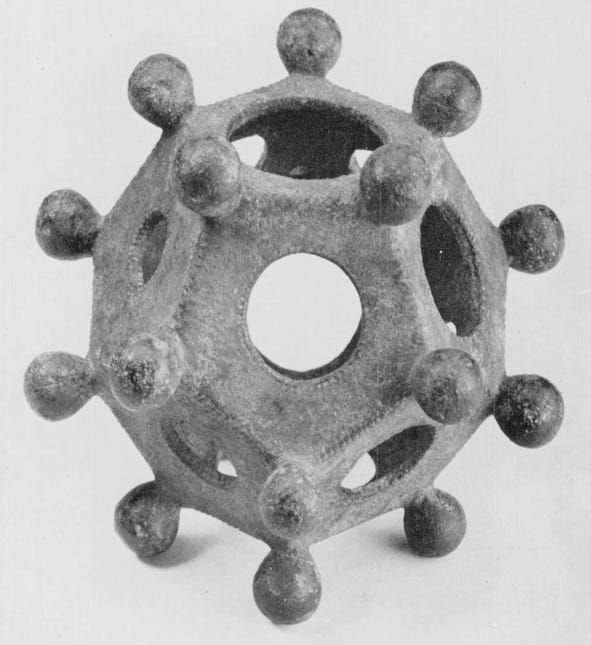
The Carmarthen dodecahedron — hollow bronze, twelve pentagonal faces, each pierced by a hole of a different, measured diameter, a knob at every vertex; cast as a single piece. Found in 1768, eight feet down at St Peter’s Church, Carmarthen.
The Carmarthen (Moridunum) dodecahedron, Society of Antiquaries of London. Archival plate after The Antiquaries Journal (1924); public domain by age. Objects of this kind have been argued over for two and a half centuries; no surviving ancient text so much as mentions one. This is where the argument begins.
Abstract
This essay advances a single, testable hypothesis: that a cluster of metal vessels and geometric objects from across the ancient world — the pierced bronze dodecahedra (conventionally, and I will argue wrongly, filed as “Roman”), the Chinese si nan and wet-needle compass, the Etruscan bronze bowls and the Liver of Piacenza, the Greek phiale mesomphalos and Delphic omphalos, the La Tène hanging bowls of Britain, the three-legged Chinese ding, Celtic spiral-work, and the Early Bronze Age cups of South Wales — are not unrelated curiosities but partial survivals of one practical idea: a bowl that orients itself. And to head off the obvious misreading at the outset: I am not proposing a single lost civilisation that invented this and seeded everyone else. I am proposing the opposite — the same simple discovery, made independently in many places and traded between neighbours. A magnetised stone (lodestone, Fe₃O₄) fixed in or beneath a vessel floated on water will, by simple magnetic torque, rotate the whole vessel until a fixed mark aligns with magnetic north. Around this mechanical core accrete its other uses — solar and astronomical sighting, the laying-out and surveying of land, and ritual divination — which in the ancient mind were not separate from finding one’s way but continuous with it: the same instrument steered the ship, set the standing stone, and aligned the temple.
If the central object here — the bronze dodecahedron — is what I argue it is, the consequences are not modest. They are large enough to be uncomfortable: the controlled, instrument-aided finding of direction — at sea and across land — would be pushed back not by decades but by millennia; the “Roman” label that quietly caps these objects at the second century CE would be exposed as a dating of their burial, not their design; and the technical sophistication of nearly every culture in which the bowl-form appears — Etruscan, Chinese, Greek, and Welsh — would have to be revised sharply upward. Much of the standard story, in which precision navigation and surveying are a late and largely European achievement, would not survive. I do not state this to overawe; I state it so the stakes of the test are clear. I set out the physics and mathematics in full, place each object in its archaeological literature with the scholarly disagreements left visible, and then read the whole assemblage through the lenses its makers actually used: number, geometry, and symbol. I argue these connections as a single coherent theory — stated plainly and built to be tested. I stake it in the open so it can be confirmed or broken, not admired from a safe distance.
A note on method, stated once and meant throughout: I distinguish carefully between what the artefacts demonstrably are, what the primary texts say, and what I am proposing. Where a popular claim does not survive scrutiny — the supposed Han-dynasty lodestone spoon, the “ethylene oracle” of Delphi — I say so plainly. An argument that hides its weak joints is not scholarship; it is advertising.
I. The question
Why does the same shape keep coming back?
A pierced bronze polyhedron pulled from the ground in Gaul, Britain, and Wales. A spoon of lodestone on a diviner’s board in Han China. A shallow gold bowl with a raised navel from the Achaemenid and Greek world. A hanging bowl dredged from an English river beside a boat. A footed cauldron on three legs from Bronze Age China. A cup from a field in the Vale of Glamorgan, four thousand years old. Put photographs of them on one table and the eye does something the catalogue does not: it groups them. They rhyme.
The orthodox answer is that the rhyme is an accident — convergent function, shared human taste for symmetry, the bowl being simply the easiest thing to beat out of sheet metal. That answer is reasonable and may be correct. But it has never been seriously tested against the alternative: that some of these objects encode a technique — a way of finding direction, time, and place using a vessel, a stone, and water — and that the technique was lost, leaving the vessels behind as orphaned hardware whose manuals had burned.
A word on what this essay is not claiming. To say one instrument recurs across the ancient world is not to say a single lost civilisation invented it and seeded everyone else — the discredited hyperdiffusion of Atlantis and ancient astronauts. I am claiming the opposite. A lodestone, free to turn, points north. That is not an invention to be guarded and passed down a secret line; it is a property of the world, lying in wait for anyone who works magnetite near still water. Discoveries of that kind get made again and again, independently — as fire, pottery, the bow and agriculture were each found many times by people who never met. What travels afterwards is only refinement: the bowl made to hang level, the float, the marked rim — drifting between neighbours who trade and intermarry, the way every useful trick seeps across a border. So the pattern here is not one origin radiating outward. It is many origins of the same simple discovery, blurred together over centuries of ordinary contact. The wonder is not that one genius culture knew it. The wonder is that it was obvious — and that we forgot.
This essay is the test, laid out as ten numbered claims. Each is staked in the open, with the evidence for and against beside it.
II. The mechanism, stated plainly
Before the claims, the engine. Everything below depends on one piece of physics a child can verify in a sink.
Take a bar or lump of lodestone — naturally magnetised magnetite, Fe₃O₄ — the one naturally occurring magnet common and strong enough to have been found and used. Fix it to the base of a light bronze bowl. Float the bowl on water. The bowl is now free to rotate about its vertical axis with almost no friction. The Earth’s magnetic field exerts a torque on the stone’s magnetic moment, and because the stone is locked to the bowl, the entire bowl turns until the stone’s axis lies along the local field. A mark scratched on the rim now points, reliably, to magnetic north.
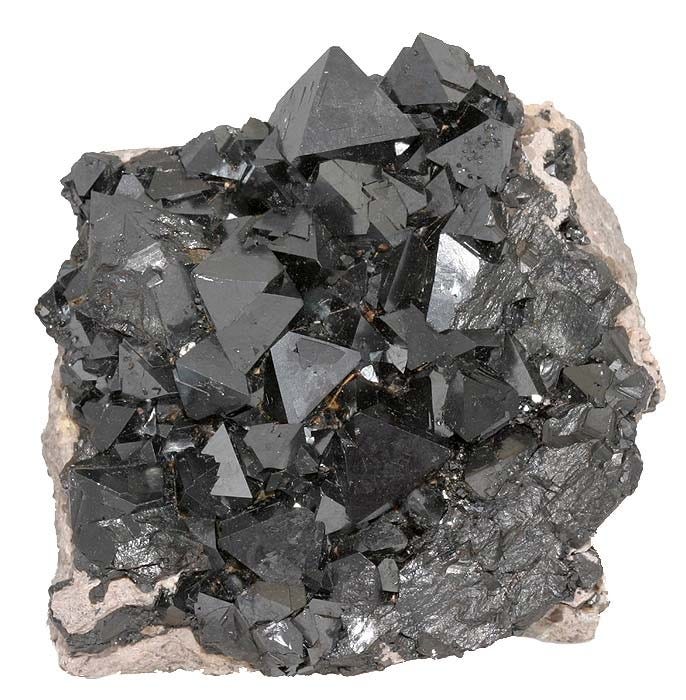
Natural magnetite — lodestone. The crystals grow as octahedra and rhombic dodecahedra; lodestone is the one naturally occurring magnet strong enough to have been put to use. Magnetite (Fe₃O₄), Bolívar, Spain. Photo Robert M. Lavinsky / iRocks.com, CC BY-SA 3.0.
The mathematics is elementary and worth seeing because it shows the device would actually work, and how well.
Torque. A magnetic dipole of moment m in a field B feels a torque
where θ is the angle between the stone’s axis and the field. The torque is zero when aligned (θ = 0), maximal across the field (θ = 90°), and always acts to reduce θ. That is the whole secret: the system has a single stable equilibrium, pointing north.
Oscillation. Displace the floating bowl by a small angle and release it. For small θ, sin θ ≈ θ, so the restoring torque is τ ≈ −(mB)θ — a linear restoring law, identical in form to a pendulum. The bowl performs simple harmonic motion with period
where I is the moment of inertia of the floating assembly about its vertical axis. A heavier bowl (large I) swings slowly and settles steadily; a stronger stone or field (large mB) snaps to north faster. An ancient maker tuning such an instrument by trial — bigger stone, lighter bowl, more water — is doing applied physics without the equations, and would arrive at a usable compass. The horizontal component of Earth’s field at South Wales latitudes is on the order of Bₕ ≈ 1.9 × 10⁻⁵ T; a fist-sized lodestone has a magnetic moment more than sufficient to drive the rotation against water drag. The device is not marginal. It is robust.
This is not speculation about a lost art. It is, almost exactly, the wet compass described in China by Shen Kuo in the Dream Pool Essays (Mengxi Bitan) of 1088 CE — a magnetised needle floated on water — and Shen Kuo already notes that it points slightly east of true south, i.e. he records magnetic declination four centuries before Europe. The floating-bowl variant simply moves the magnet from a needle on the water to the hull of the vessel. Tesla’s intuition that “everything is waves and fields” is, here, just literally true: the bowl reads a field.
And lest anyone object that the ancient West knew nothing of this force — it knew it for a thousand years before these objects went into the ground. Thales of Miletus described the lodestone's pull on iron around 600 BCE; Plato names the "stone of Heraclea" in the Ion; Lucretius, c. 60 BCE, gives a passage of De Rerum Natura to magnetic attraction — iron rings set swinging in the stone's invisible reach, a field described in verse. Pliny goes further: he records that the architect Timochares had begun, in the third century BCE, to vault the temple of Arsinoë at Alexandria in lodestone so that an iron statue of the queen would hang suspended in the air. That is not idle knowledge of a curiosity; it is ancient magnetic engineering. The Mediterranean world had the stone, knew its power, and built with it. The one application supposedly never imagined — the one written out of the record — is the simplest of all: to let the stone point.
Picture the finished instrument, because this is the image the whole essay is built to recover. A shallow bronze plate floats in a basin of water, turning freely; at its centre sits the pierced dodecahedron, and beneath it the lodestone, so that the bowl swings of its own accord until a scratched mark on the rim holds steady on north. A figure bends over it — on a heaving deck, or on a hilltop above a half-built avenue of stones — and sights through one chosen pair of the dodecahedron’s graded holes: a star, the rising sun, a far cairn on the skyline. The rim gives him his bearing from north; the holes give him his angle to the mark. With those two readings he can hold a course at sea, step a line of standing stones across miles of moorland, or fix the axis of a tomb to the midwinter sunrise. One floating bowl, one pierced solid, one stone that points — a compass, a theodolite, and a calendar in a single fist of bronze. Everything that follows is the attempt to find this object again, in pieces, scattered through the museums of the world.
Hold that engine in mind. Now the claims.
III. The ten claims
Claim 1 — The bronze dodecahedron is an instrument, not an ornament — and one came out of the ground at Carmarthen
This is the central claim, and it is best made on Welsh soil. In May 1768, workmen digging on the north side of St Peter’s Church, Carmarthen — the site that would much later be wrapped in the Roman name Moridunum — brought up, from a depth of about eight feet, a “singular object of bronze, in form of a hollow dodecahedron, with a ball attached to each angle; each of its pentagonal sides pierced with a circular opening, the diameters of these perforations increasing gradually from six-tenths to about one and a half inches.” It was published in The Antiquaries Journal 4.3 (1924) — under the title “Roman Dodecahedron from Wales,” and that title is the first thing I want to question. It survives in the collection of the Society of Antiquaries of London, and it is the object with which this essay opens.
On the word “Roman.” I do not call these objects Roman, and the reader should notice how automatically the label is applied. What the archaeology actually establishes is that a number of them were deposited in Roman-era ground; it does not establish when the design was conceived, and there is no Roman text, drawing, or workshop record that mentions them at all — an astonishing silence for a supposedly Roman artefact made in the hundreds. A label that records the date of a burial and then quietly becomes the date of an invention is not a neutral act of cataloguing; it is a ceiling lowered onto the evidence. The Carmarthen piece came up eight feet down from an eighteenth-century spade that recorded depth, not stratigraphy — we do not in fact know it is “Roman” in any sense stronger than “found where Romans later were.” Throughout this essay I therefore call it what it is: a bronze dodecahedron, and I treat its true antiquity as an open question whose answer is very probably far older than the second century CE.
And it is worth being blunt about the mechanism of the mislabelling. When an object made by a conquered people is dug from the conqueror’s ground, it is the conqueror’s name that ends up on the label; the skill is quietly reassigned upward to the “civilising” power, and the people who actually cast it are written down as decorative, or primitive, or simply absent. “Roman” on these objects is doing precisely that work. The pre-Roman peoples of Gaul, of these islands, and of Wales — including the Druidic learned class the Romans feared enough to hunt to extinction — were not the passive recipients of Mediterranean cleverness. On the evidence of the bronze in the ground, they were ahead of it.
Two details matter enormously. First, the holes are of graded diameter — measured, in the 1924 description, as increasing “gradually from six-tenths to about one and a half inches.” This is not decoration; it is a scale. Second, the Carmarthen example was cast as a single piece, the balls included, where most Continental dodecahedra have their knobs soldered on separately — a mark of deliberate, high-skill manufacture, not a casual trinket. That such an object was buried eight feet deep, at a settlement that became the seat of a Welsh bishopric, at the very church (St Peter’s) whose later registers carry the names this author tracks elsewhere, is the kind of coincidence that asks to be excavated rather than waved away.
The Carmarthen piece is one of about 130 such hollow bronze objects, and here is the fact that ought to stop the word "Roman" in its throat: not one has ever been found in Rome, in Italy, or anywhere in the Mediterranean heartland of the empire. They cluster instead in the old Celtic north-west — Gaul, Britain, the Rhineland — the provinces, never the centre. And, to repeat the point that ought to be deafening, not one is mentioned in any surviving classical text. An object the Romans neither made in their own homeland nor ever once wrote down is not, in any honest sense, a Roman object — it is a native object that happens to survive from the centuries of occupation, and the label "Roman" is the conqueror signing his name to what he found already there. Here is a typical Continental example for comparison:
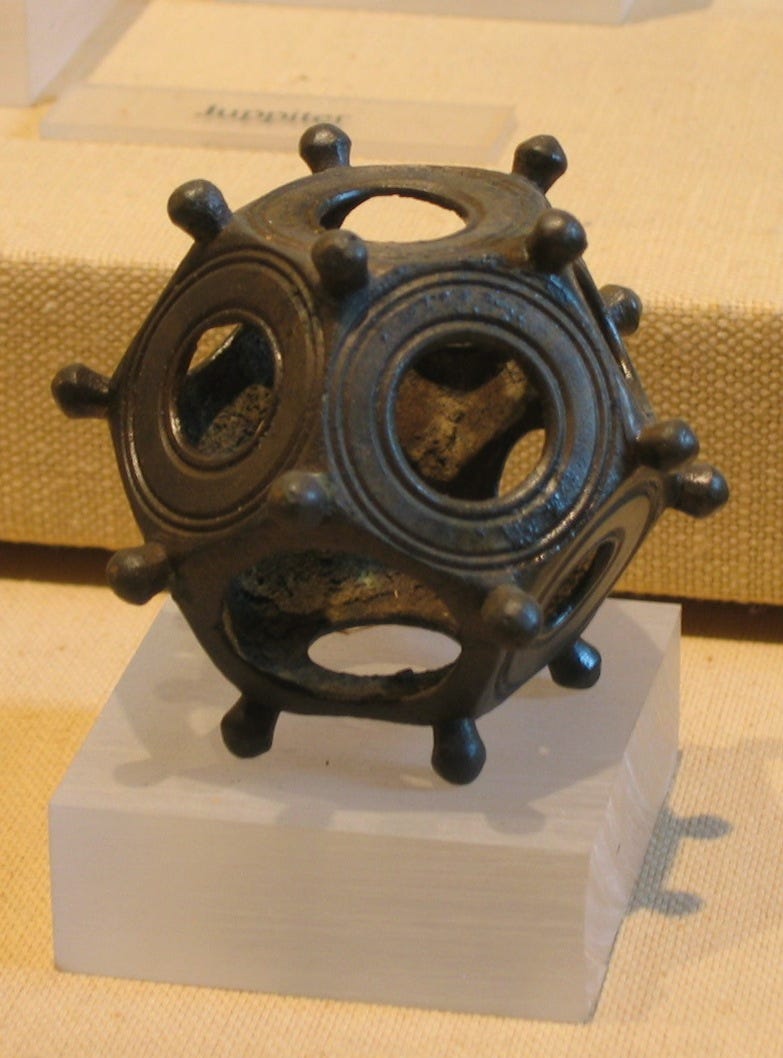
A bronze dodecahedron: twelve pentagonal faces, each pierced by a hole of a different diameter, a knob at every vertex. Bronze dodecahedron (conventionally dated by its burial context to the early centuries CE — a dating this essay disputes). Photo “Itub”, CC BY-SA 3.0.
Twelve regular pentagonal faces, each pierced by a circular hole of a deliberately different diameter, a small knob at each of the twenty vertices. No two holes the same size: that is the detail every “candlestick” or “ornament” theory fails to explain, and the detail every measuring theory needs.
The geometry is Platonic in the literal sense. The regular dodecahedron is one of the five Platonic solids: Schläfli symbol {5,3},12 faces, 20 vertices, 30 edges, dihedral angle
its dual the icosahedron. In Plato’s Timaeus the other four solids are assigned to the four elements, but the dodecahedron is set apart: “there was yet a fifth combination which the god used in the delineation of the universe” (Timaeus 55c) — the shape of the cosmos itself, later named aether, the heavens. To an ancient mind a twelve-faced solid was not neutral. Twelve is the number of the zodiac, the months, the hours of the doubled day. A twelve-holed sighting device is a calendar and a star-frame before it is anything else.
My proposal, held as hypothesis: the differing hole diameters are a sighting set. Looking through a chosen pair of opposite holes frames a fixed angular field; matching a star, the sun’s disc, or a distant landmark to a particular pair gives a repeatable angular measurement — the function of a dioptra or a pelorus, the surveyor’s sighting instruments, the tools by which a road is run straight, a boundary fixed, and a monument aligned to the heavens. Mounted over the floating bowl of Section II, the dodecahedron becomes the sight and the bowl the bearing-plate: read the star through the holes, read north off the rim. Astronomy, magnetism, and the measuring of the land in one fist.
And note the sequence this implies: the sight need not itself turn. The floating bowl finds north on its own — a magnetised sliver on water settles in seconds — and the dodecahedron is then set upon that established bearing, its holes read off a north already fixed. The bowl is the compass; the dodecahedron is the theodolite laid over it. Two instruments used in turn, not one device asked to do both at once.
The test. No dodecahedron has yet been excavated beside its lodestone, its float, or a text naming its use — and the museum readings on offer (a range-finder, a knitting frame, a votive trinket) share one fatal failing: not one of them explains the single stubborn fact, the graded holes. Mine does. The dodecahedron is a combined magnetic-and-astronomical sight, and the holes are its calibrated apertures. That is a claim, and it is falsifiable: build a faithful replica, mount it over a floating lodestone bowl, and test whether the hole-set yields consistent solar and stellar bearings at the latitudes where these objects are found. If it does not, the theory fails here — and I expect it to hold.
Claim 2 — The whole bowl rotates: the si nan and the lost Western float
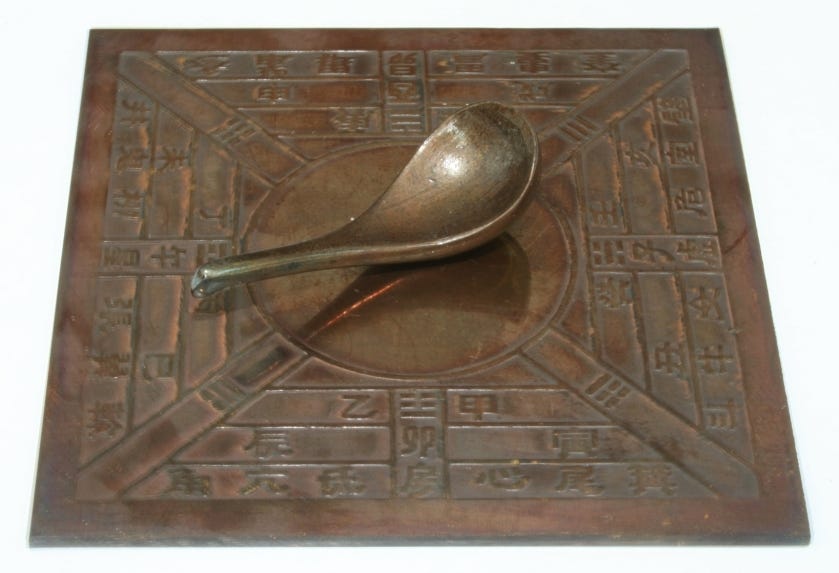
Modern reconstruction of the Han “south-pointing” device: a lodestone spoon on a bronze diviner’s board (shi). Reconstruction of the si nan, after Wang Zhenduo. Photo CC BY-SA 3.0.
The oldest attested magnetic direction-finders are Chinese, and they come in exactly the two forms my mechanism predicts. The first is the wet compass — needle on water — already met above. The second is the si nan (司南, “south-governor”), described by Wang Chong in the Lunheng (Discourses Weighed in the Balance, c. 80 CE): a “south-controlling spoon” that, set spinning on a smooth board, comes to rest pointing south. The standard reconstruction (Wang Zhenduo, 1940s) makes the spoon itself of lodestone, its bowl-shaped belly pivoting on the polished bronze of a shi — a diviner’s cosmograph marked with the cardinal directions, the trigrams, and the lunar mansions. It was a tool of geomancy and the siting of graves before it was a tool of travel. Direction-finding was first a sacred act: aligning the dead, and the living house, with the axis of heaven.
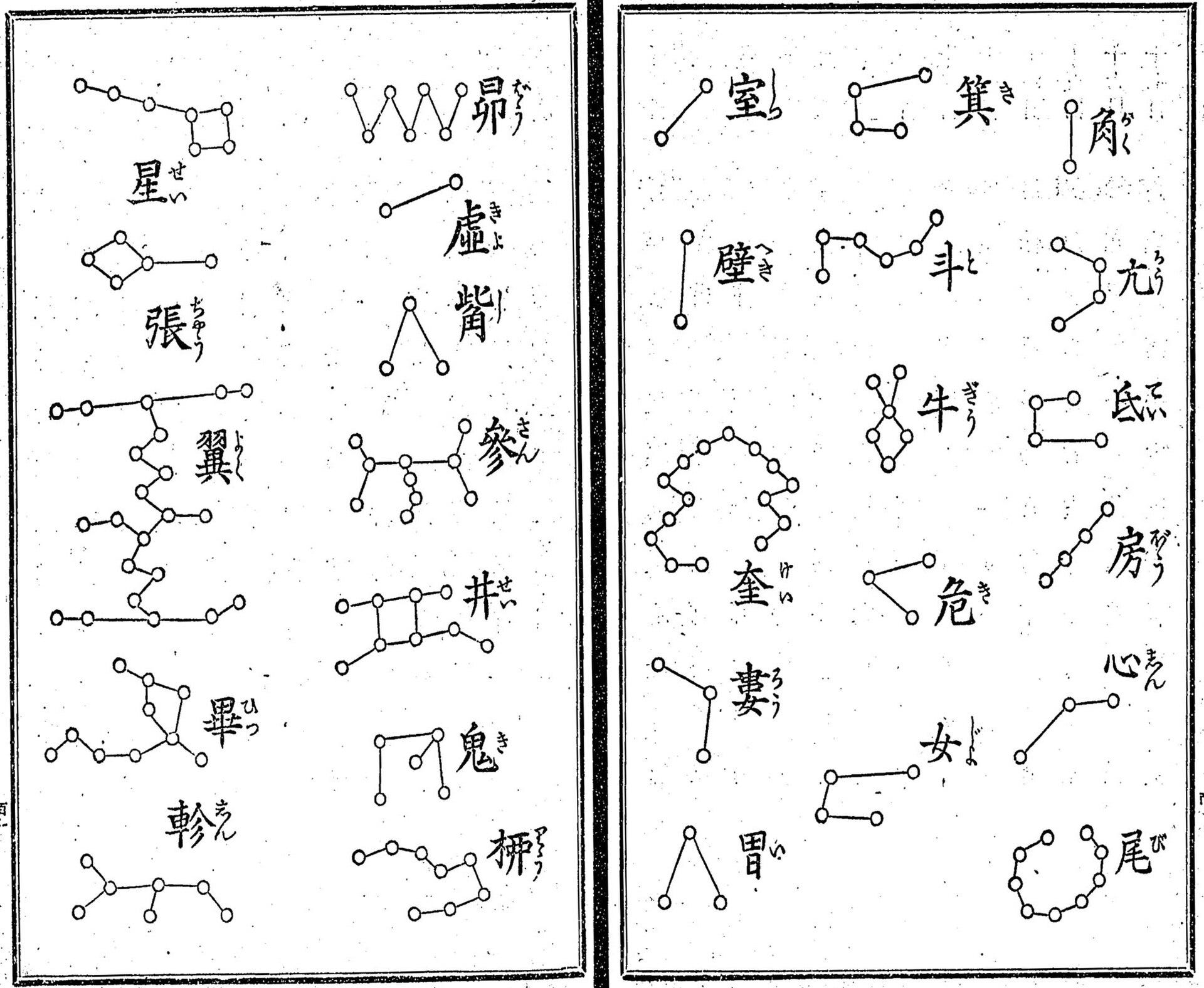
The twenty-eight lunar mansions (xiu) of the Chinese sky — the divisions marked on the diviner’s board around which the si nan turned. The same 28-fold division of the heavens appears in the Indian nakshatra and the Arabic manazil. The twenty-eight lunar mansions. Public domain.
The board the spoon turns on is itself a star-map: the sky divided into twenty-eight lunar mansions (xiu), one for each day the Moon takes to circle the sky against the stars (the sidereal month is 27.32 days, rounded to a 28-station calendar). The same 28-fold division appears independently in the Indian nakshatra and the Arabic manazil — a shared lunar bookkeeping stretched across Asia. So the si nan is not merely a pointer: it is a magnet turning over a calendar of the Moon. Direction and time are read off the one instrument.
And the principle was found more than once, alone, by peoples who never met. In the 1960s a deliberately shaped and polished bar of magnetic haematite was excavated at the Olmec city of San Lorenzo in Mexico, from a layer dated to 1400–1000 BCE — a full thousand years before the si nan. The astronomer John B. Carlson floated it, found it oriented consistently, and published the result in Science in 1975 under a title that frames the whole question: "Lodestone Compass: Chinese or Olmec Primacy?" The reading is contested — others call the bar part of an ornament — and I flag it as contested, as I do my own weak joints. But primacy is not the point. The point is that a people on the far side of an ocean they could not cross, with no conceivable contact with China, shaped a magnetic bar that points. That is independent invention caught in the act — and it is exactly what Section I argued: not one lost civilisation seeding the world, but the same fact of nature, that a magnetised stone aligns itself, discovered again and again by anyone who picks up the rock.
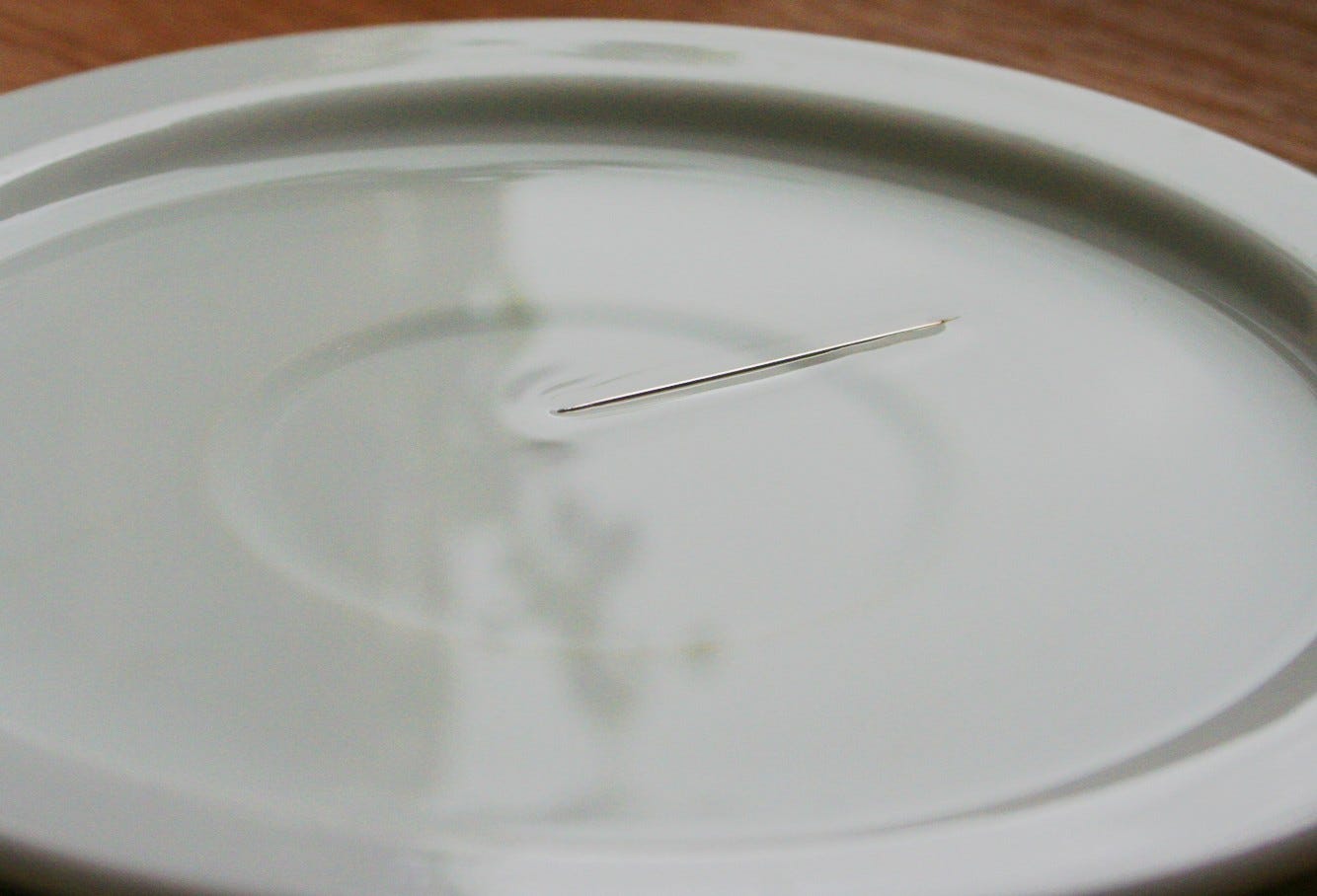
A magnetised needle floating on water, turning of its own accord to north — the wet compass Shen Kuo described in 1088, and the simplest form the instrument can take. Photo: CC BY-SA 3.0.
The conceptual leap I want to mark is small but total. In the si nan a magnetic object turns on a fixed plate. In the wet compass a magnetic needle turns on water. Float the lodestone-bearing vessel itself, and the third form appears: the whole bowl turns. This is mechanically the most stable of the three — a low, water-borne mass has enormous rotational steadiness against the chop of a real sea — and it is the form most likely to leave behind, in the archaeological record, just a bronze bowl with a stone in it, indistinguishable to a cataloguer from a cooking pot or a libation dish. The instrument would hide inside the category “bowl.” That is the claim: the most seaworthy ancient compass is the one we would be least able to recognise as a compass.
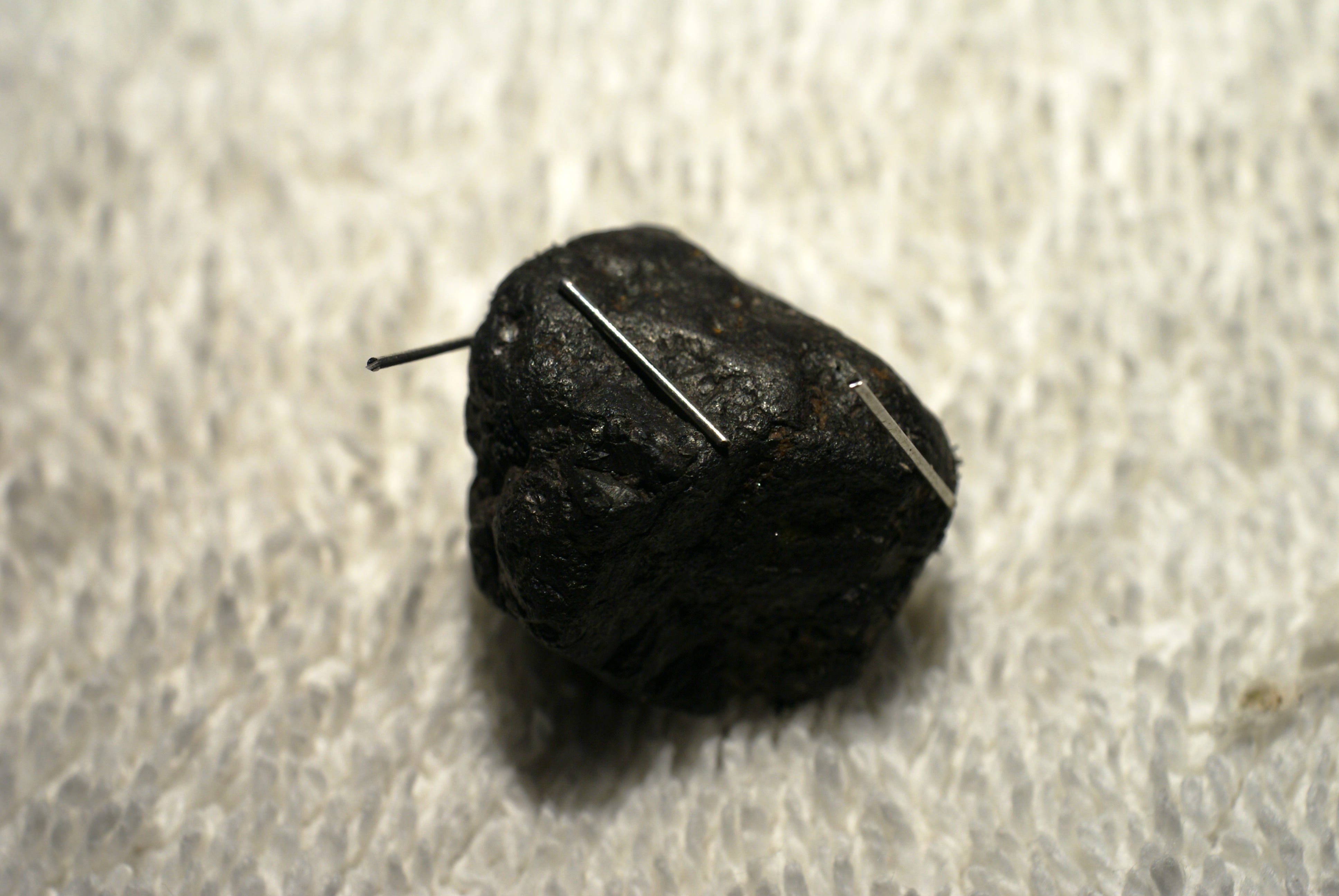
Lodestone with iron pins — Teravolt, CC BY 3.0. https://commons.wikimedia.org/wiki/File:Lodestone_(black).jpg
A natural lodestone (magnetite) with iron pins clinging to it — the stone magnetises the iron. Float one such magnetised pin on water and it turns to north: the indicator of the earliest compasses, and the part a catalogue is least likely to keep. Photo: Teravolt, CC BY 3.0.
And the indicator is the part that was never going to survive. The needle of such a compass need be nothing more than a thin leaf of iron — a flat sliver, an oval no larger than a fingernail — laid on the water, where surface tension holds it and the earth's field swings it true. This is the oldest floating compass on record: the Chinese south-pointing fish of the Wujing Zongyao (c. 1044) was exactly that, a fish-shaped sheet of iron heated to red heat and quenched while held north–south, fixing its magnetism as it cooled. Bronze bowls keep; lodestones keep; a wafer of iron does not — it rusts to nothing, or it is lifted from the ground and filed under another name. When a Roman ritual deposit at Sardis was opened, it held a bronze bowl sealed over a smaller one, and inside, among eggshell and coin, a single bronze needle — catalogued, reasonably enough, as protective magic. The working part of the instrument is precisely the part a catalogue loses: a pin, a needle, a splinter of corroded iron. We should not be surprised that no bowl has been dug up with its indicator intact.
The contested part, named as such. No Han-era lodestone spoon has ever been excavated; the si nan as a magnetic instrument is a reconstruction from a handful of terse texts, and some historians read Wang Chong’s “south-pointing spoon” as the constellation of the Dipper rather than a magnet. So I do not rest the case on the spoon. I rest it on what is beyond dispute — the wet compass and Shen Kuo’s recorded declination of 1088 — and take the spoon for the principle it preserves: a magnet on a marked plate.
Claim 3 — The phiale mesomphalos: a portable navel of the world
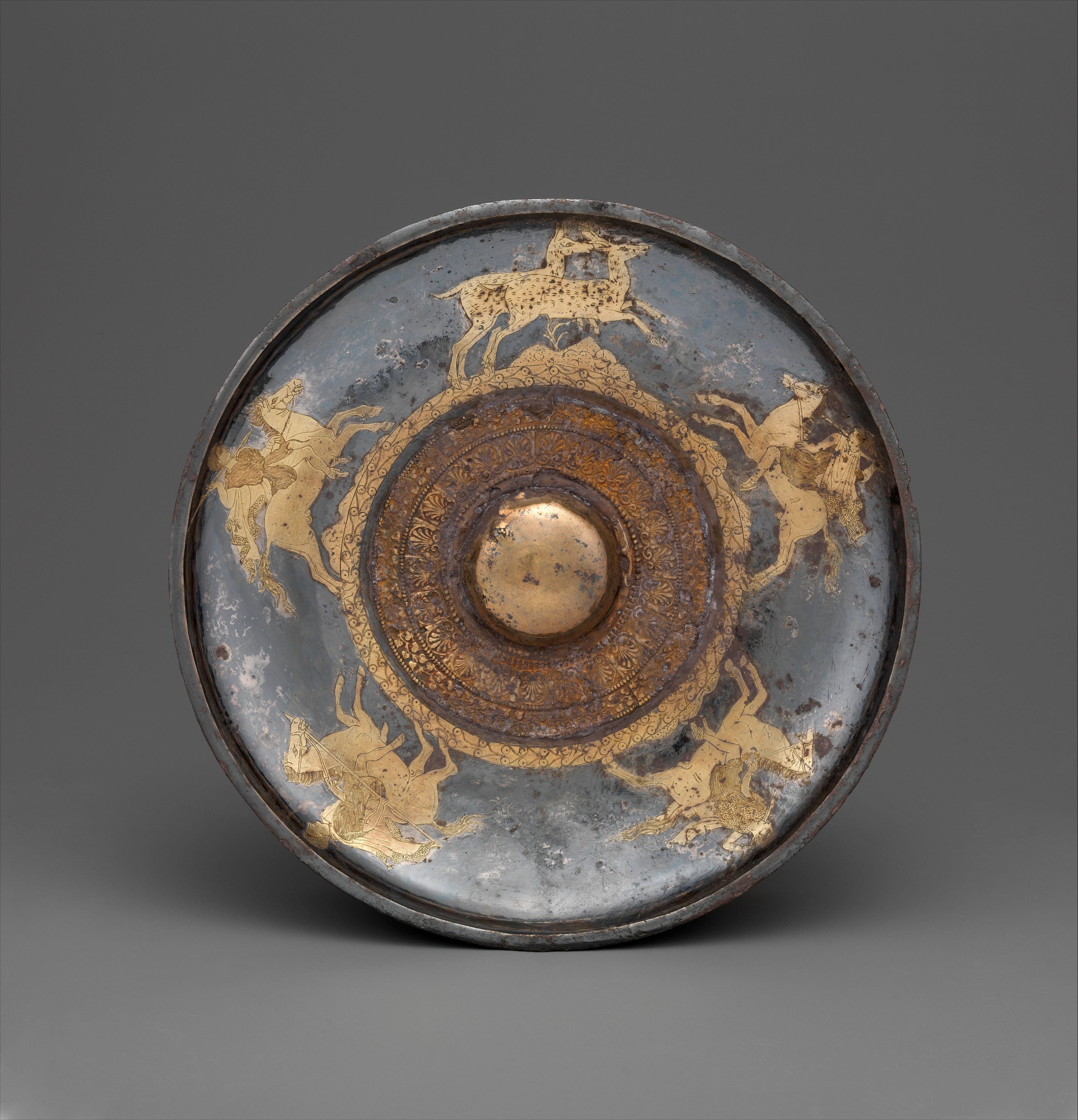
Gilt-silver phiale mesomphalos with four hunters on horseback, late 5th century BCE. The Metropolitan Museum of Art, acc. 2015.260.3, Open Access / CC0.
The Greek and Achaemenid world is full of a very particular bowl: the phiale mesomphalos — shallow, handle less, with a raised boss (omphalos, “navel”) rising in the centre. The standard explanation is ergonomic: you hook your fingers under the boss to pour a libation one-handed. True, as far as it goes. But look at the form and then look at this:
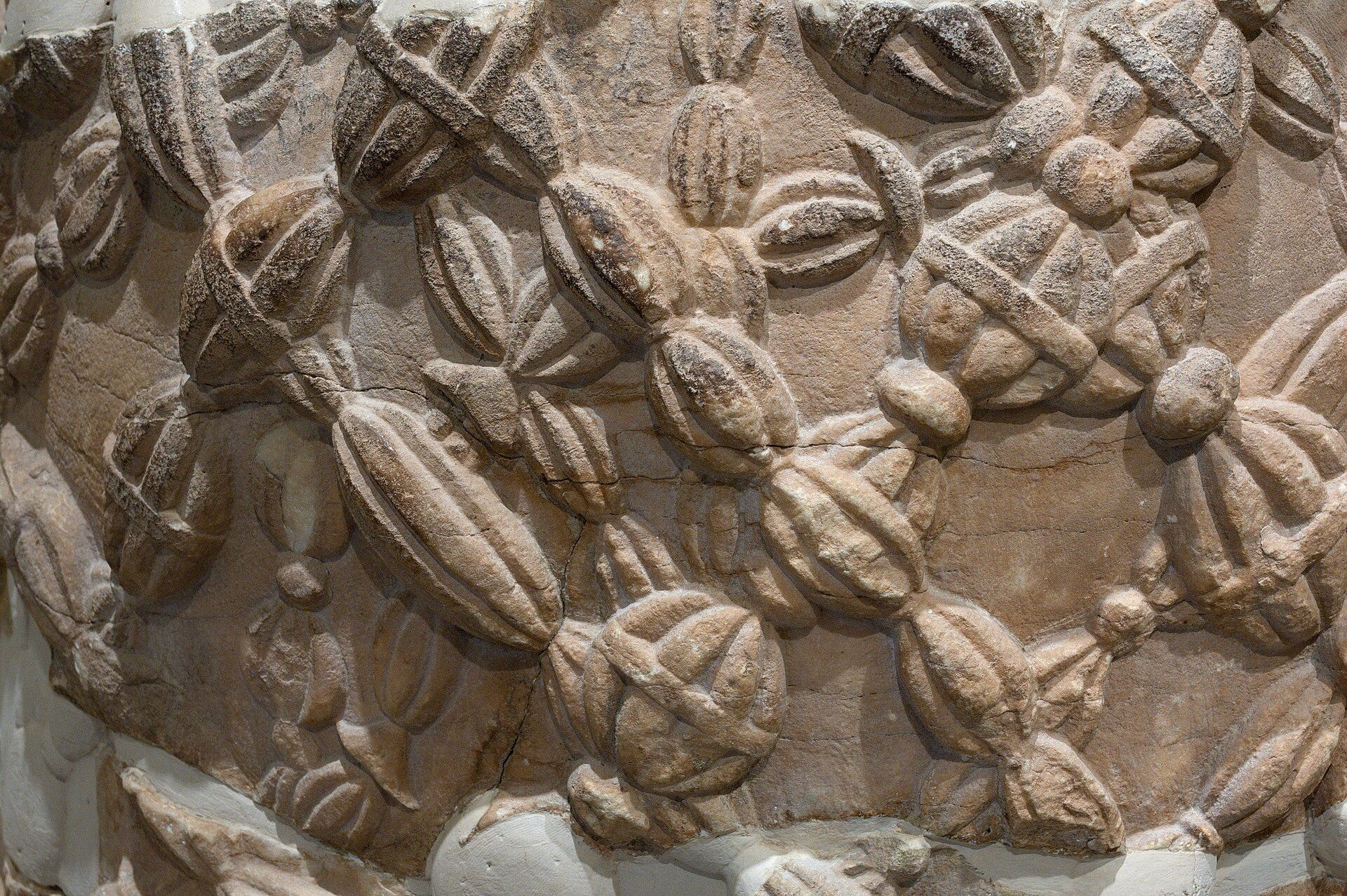
The omphalos of Delphi: the carved stone that marked the navel of the world, where Zeus’s two eagles met. The omphalos of Delphi, Archaeological Museum of Delphi. Photo “Zde”, CC BY-SA 4.0.
The omphalos of Delphi was the stone that marked the centre of the Earth — the point where, in the myth, the two eagles Zeus loosed from the ends of the world flew to meet. Delphi was a geodetic claim: here is the centre, and all bearings are taken from here. The phiale’s raised navel is the omphalos in the palm of the hand. A bowl with a centre-point is the minimum apparatus for a survey: a fixed origin from which angles are measured. Set a sighting-stone or a needle on that central boss, float the dish, and the libation bowl becomes the bearing instrument of Claim 2 — the omphalos the pivot, the rim the dial. The “navel of the world” is, read this way, a portable origin of coordinates: wherever you set the bowl, there is the centre, and the world arranges itself in angles around it.
And notice what the form is doing. That the same raised centre serves as (a) the navel of the world at Delphi, (b) the handgrip of a sacred bowl, and (c) the pivot of an orienting instrument is not three coincidences but one idea — a fixed centre from which everything else is measured — worked in stone and in bronze. This is the root of surveying as much as of myth: the survey of a landscape and the survey of the cosmos begin in the same act. You plant a centre, and the world arranges itself in angles around it.
Look, finally, at what is on such a bowl. The Metropolitan's gilt-silver phiale carries, around its outer ring, four horsemen spaced to the four quarters, riding forever after a single deer that climbs to the summit and is never taken. Read as a picture it is a hunt; read as the instrument the form already is, it is a sky. The four riders stand at the cardinal points — north, south, east, west — and the chase that never ends is the turning of the year about a fixed centre. The hunter is the oldest one there is: Orion, whose belt rides the celestial equator, who rises due east and sets due west and so is the marker of the cardinal line; the quarry that climbs to the top and is never caught is the circumpolar star that never sets. Held by its navel and turned in the hand, the bowl turns the heavens about their pole. And here is the tell: the museums record this scene, with great care, as "four youths hunting a deer" — and stop. The catalogue describes the figures and declines the meaning. The imagery of an instrument is filed as ornament, exactly as the instrument itself is filed as tableware.
Claim 4 — The hanging bowls of Britain were found with boats
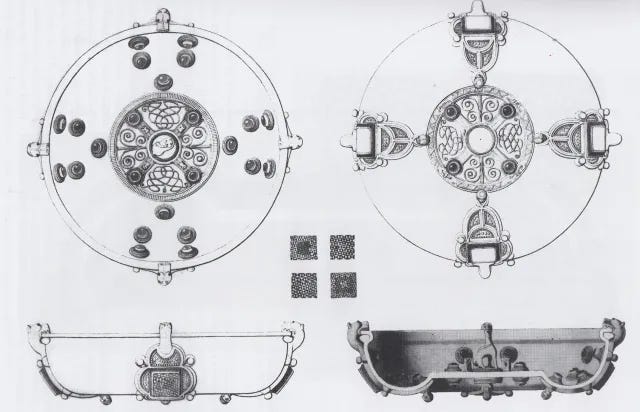
Celtic hanging bowls in plan and section — thin bronze vessels suspended level from three rings, their escutcheons inlaid with enamel and millefiori. Celtic hanging bowls, plan and section. Archival illustration plate, public domain by age.
British and Irish archaeology is full of hanging bowls — bronze vessels suspended by three (or more) chains from decorated escutcheons, recovered again and again from rivers, lakes, and graves, often in association with boats and waterborne deposition. Rivers like the Witham in Lincolnshire are among the great “ritual” rivers of Britain, places where the finest metalwork — hanging bowls among it — was deliberately given to the water over centuries.
The orthodox reading of a hanging bowl is a hanging lamp or a serving vessel for the feast. But a bowl that hangs free on three chains is a gimbal — it stays level as its support pitches and rolls. That is precisely the requirement of a marine instrument: a compass or a lamp that must stay horizontal on a moving deck. A three-point suspension is the simplest gimbal there is, and we will meet the magic of three points again at Claim 6. A bronze bowl, suspended level, floating an indicator, deposited with boats, in a river that swallowed the era’s best technology: every one of those facts is consistent with a maritime orienting instrument, and the cluster of them is, at minimum, a question the “lamp” theory does not answer.
Sutton Hoo names it for us. The single richest grave in early-medieval Britain — Mound 1 at Sutton Hoo in Suffolk, c. 625 CE — is a twenty-seven-metre ship dragged up from the river Deben and buried whole, with a king’s hoard packed inside it. Among that hoard sat a great bronze hanging bowl and a nest of cauldrons: a bowl built to hang level, laid inside a ship. If you wanted to bury a mariner’s orienting instrument with its mariner, this is already close to what it would look like.
But the bowl itself goes further than that. At its centre, rising from an enamelled boss, stands a free-standing bronze fish on a pedestal — and it revolves; from the fish’s mouth there once projected an iron rod. A pivoting fish carrying an iron rod, mounted dead-centre in a vessel made to hang perfectly level: that is not a reading I am forcing onto the object — it is the object. And the obvious inference has already been put in print by the keepers of the thing themselves. The British Museum's own catalogue entry for the bowl (registration 1939,1010.110) records that "it has been suggested, on Chinese analogies of relevant date, that the iron rod once apparently protruding from the mouth of the rotating fish might have been magnetized and used for navigation" — and then, far from burying it, concludes that the idea "cannot be scientifically supported but should not be dismissed out of hand." The institution that holds the object has left the door standing open. This essay is the address that proof was waiting for. The “Chinese analogies” are Claim 2 of this very paper — the si nan and the floated lodestone; the iron indicator turning at the centre of a level bowl is the technique I have been describing from the first page. The compass was lifted out of the ground at Sutton Hoo in 1939. It was catalogued as a hanging bowl.
And if a misread instrument sitting unrecognised in a museum case sounds far-fetched, it has already happened once, with the most celebrated object of its kind. The Antikythera mechanism was raised from a Greek shipwreck in 1901 and dismissed as a corroded lump for the better part of seventy years — until someone took its gears seriously and found a geared astronomical computer two thousand years ahead of anything that was supposed to exist. The orthodoxy did not merely fail to see it; it held that such a thing could not be. It was wrong. The museum's confidence was not evidence then, and it is not evidence now.
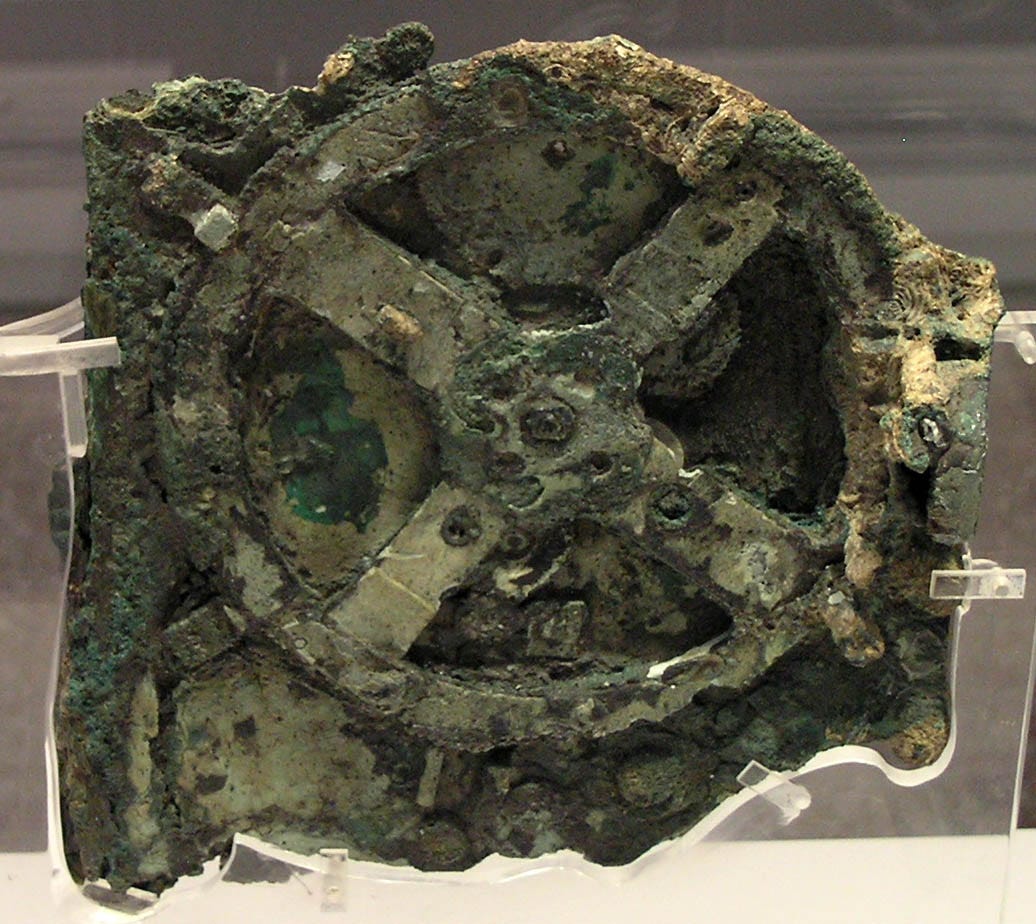
The Antikythera mechanism (Fragment A), National Archaeological Museum, Athens (cat. 15987), c. 1st century BCE. Photo "Marsyas", CC BY 2.5.
And the dismissal of ancient navigation as fancy has a second, even sharper rebuttal. For decades the Norse "sunstone" — a crystal said in the sagas to find the sun through cloud and fog — was treated as a sailor's legend, because no such stone had ever been recovered. Then, in the wreck of an Elizabethan warship that sank off Alderney in 1592, divers found a worn block of Icelandic calcite; and in 2013 a Franco-British team led by Guy Ropars and Albert Le Floch showed, in the Proceedings of the Royal Society A, that the crystal's natural birefringence will fix the position of the hidden sun to within a degree. A navigational instrument dismissed as myth for want of a surviving example turned out to be real the moment one was dug out of the sea-bed. That is exactly the position the bowl-compass stands in now — and exactly why "no labelled example survives" is an objection that has already collapsed once, in living memory.
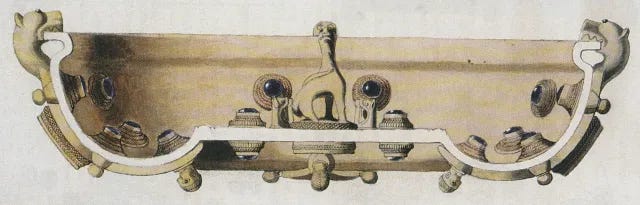
The same arrangement drawn in close reconstruction: a small fitting on a central pedestal, standing at the dead centre of a suspended hanging bowl. The pivoting central indicator — not the site it came from — is the feature that matters. Public domain by age.
The objection, met head-on. The compass reading of these bowls is usually waved away with one counter: some have an iron band round the rim, and iron near a floated magnetic needle would spoil it. It is a fair point — against the weakest version of the idea. It bites only on a free-floating needle, and only on the subset of bowls that are iron-rimmed; it says nothing about the rest, and nothing about the mechanism actually present at Sutton Hoo — a magnetised rod pivoted at the dead centre, in the mouth of the revolving fish, driven by a far stronger moment than any floating pin. And it leaves the real anomaly untouched: why band a bronze bowl with iron at all? A soft-iron ring is as readily a keeper that holds a magnet's charge as a flaw that ruins it. Which of the two it is cannot be settled by assertion — only by the replica, built with the rim and without it, and measured. The objection names the experiment; it does not win it.
And it is not one freak find. The St Ninian’s Isle treasure from Shetland — Pictish silver, hidden under a church floor and recovered as a buried hoard of bowls — sits at the far northern end of the same seaway; hanging bowls recur in Pictish and Irish contexts the length of the coasts. The form clusters exactly where the sea-roads run: Suffolk, Shetland, the Irish Sea, the great ritual rivers. A bowl made to hang level, found again and again along those coasts and in the boats that worked them, is behaving like a thing of the sea, not the feast-hall.
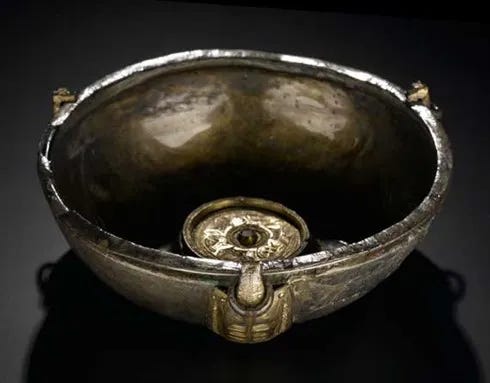
A bowl from the St Ninian’s Isle treasure — Pictish silver with a central boss, part of a buried hoard from Shetland. A bowl from the St Ninian’s Isle treasure, Shetland (National Museums Scotland). Photograph used for reference.
The claim, plainly. A bronze bowl built to hang free and swing level — a three-point gimbal — and deposited again and again with boats in the rivers that swallowed the age’s finest metalwork is an orienting instrument; the “hanging lamp” reading is the timid one. “Hanging bowl” covers a long span, and many examples are later and ornamental, so I claim the function, not every object that bears the name. The plate above shows the suspended form, not one named excavated bowl — the actual bowls are held by the British Museum and the National Museum and described here.
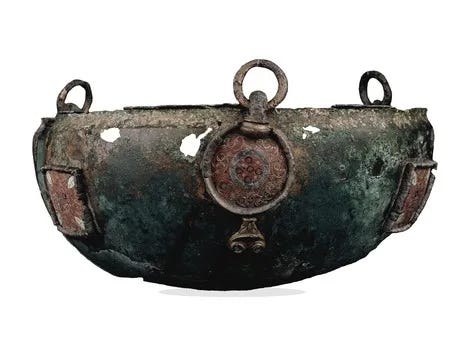
The Sutton Hoo hanging bowl itself, lifted from the Mound 1 ship burial (object held by the British Museum).
Claim 5 — South Wales held the form four thousand years ago
There is an Early Bronze Age cup from Llanblethian, in the Vale of Glamorgan (National Museum Wales, acc. 38.37/1), dated to around 1950 BCE — described by the museum’s own archaeologists as one of the earliest such vessels from the region. I name it deliberately. The argument of this essay is usually told as a story of the Mediterranean and China, with the Atlantic west as a late, passive recipient. The Welsh material refuses that framing. The bowl-form, in fine workmanship, is present in South Wales in the second millennium BCE — contemporary with, not derivative of, the eastern traditions. If a technique of the vessel travelled, the Atlantic seaboard was not its terminus but one of its hearths. Welsh primary evidence is not required to prove itself against an eastern standard; the eastern story must account for the western finds.
And look at what kind of cup it is. Excavated by W. F. Grimes from a round barrow at Breach Farm in 1938, deposited with the cremated remains of four people, it is a miniature suspended bowl: two small perforations in its wall show it was made to hang or be tied — exactly as the hanging bowls of Claim 4 hang. Its incised ornament was packed with red ochre and white calcined bone in alternating bands, a radial scheme worked around the whole vessel; and, most tellingly of all, a sun-like pattern is set on the base of the cup, deliberately placed to be seen. A small Bronze Age vessel, built to be suspended, carrying a solar wheel on its underside meant to be looked at, is not a cup for drinking. It is the form of the orienting bowl — suspended, radial, sun-marked — shrunk to the palm and given to the dead.
And the dodecahedron of Claim 1 doubles the point. South Wales does not merely hold the Bronze Age bowl; it held, eight feet under Carmarthen, one of the finest dodecahedra in the entire corpus — single-cast, graded-holed, deliberately buried. The two ends of this essay’s chronology, the 1950 BCE cup and the dodecahedron (whatever its true date), are both Welsh finds. Whatever the technique of the orienting vessel was, and however far it travelled, it passed through this ground and left its hardware in it.
The reading. The Breach Farm cup is a votive model of the orienting bowl — the instrument abstracted into a sacred object and buried, the way a culture commits to the ground a symbol of what it holds powerful. The suspension-holes, the radial red-and-white scheme, and above all the sun-disc on the base are the working features of the bowl translated into ritual form. Ffion Reynolds, who published the cup, reads its ochre-and-bone inlay in frankly shamanic terms — as “a power object, incorporated with ancestral material.” The working bowl orients the living; the votive bowl orients the dead. The date, the accession number, and Reynolds’s description are taken from her account of the cup.
Claim 6 — Three legs: the geometry of stability
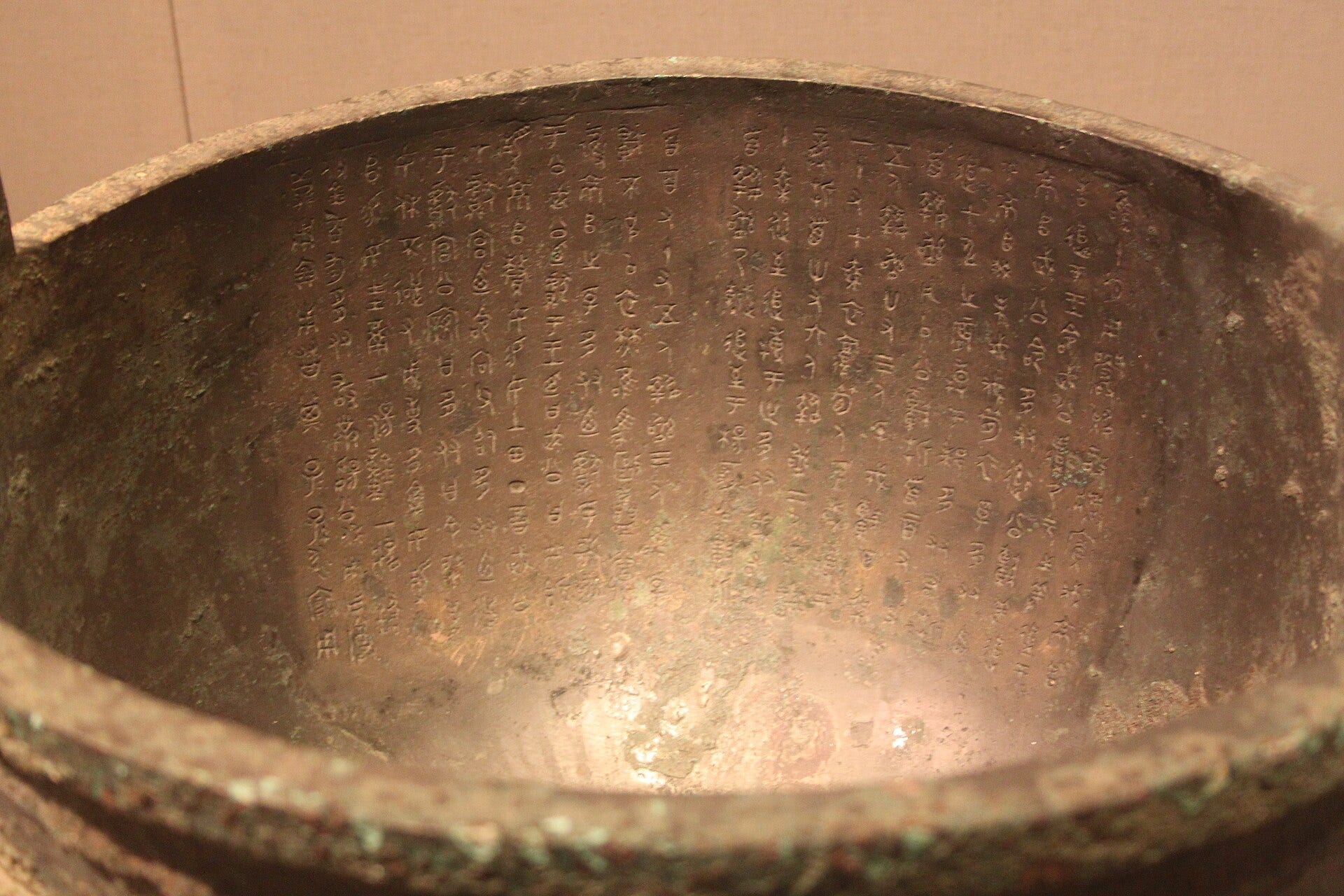
A three-legged Chinese bronze ding. Three points cannot wobble: a tripod defines a plane exactly. Bronze ding, Late Western Zhou. Photo Gary Lee Todd, CC0.
The Chinese ritual cauldron, the ding(鼎), stands on three legs. So does every camera tripod, every theodolite, every surveyor’s instrument ever made. The reason is a theorem, not a taste:
Three non-collinear points determine exactly one plane.
Two legs fall over. Four legs rock — on uneven ground only three of them touch, and which three is unstable. Three legs cannot wobble and cannot rock. A tripod is the unique minimal structure that is both stable and self-levelling on any surface. An instrument that must hold an angle — a sight, a level, a bowl that has to stay true — wants three feet, and the ancient world knew it in bronze long before it knew it in geometry. The ding was the supreme ritual object of Chinese civilisation, the vessel in which the Mandate of Heaven itself was symbolised; “to ask the weight of the cauldrons” meant to covet the empire. That the most sacred vessel is built on the surveyor’s tripod is the claim: stability was holy because stability was useful — the level cauldron and the level sight are the same problem solved once.
There is a numerical undertone here I will not over-press but will not hide: three legs, three chains on the hanging bowl, three points to fix a plane. The number three keeps appearing at exactly the structural joints of these objects. Hold that for the conclusion.
Claim 7 — The Etruscan set: a bronze bowl, a ring-stone, and a Western diviner’s board older than Rome
The vessel half of the instrument did not wait for Rome. The Etruscans — the people Rome conquered and then quietly inherited — were among the finest bronze-workers of the ancient Mediterranean, and their bronze bowls survive in numbers from the fifth to the third centuries BCE. One such object, presently on the open market, is catalogued plainly as an “Ancient Etruscan Bronze Bowl, 5th to 3rd Century BC,” measuring 11 cm wide and 8 cm tall — exactly the scale of vessel the floating-compass mechanism of Section II requires, and centuries before the dating conventionally pinned on the dodecahedra. The object itself, photographed for sale:
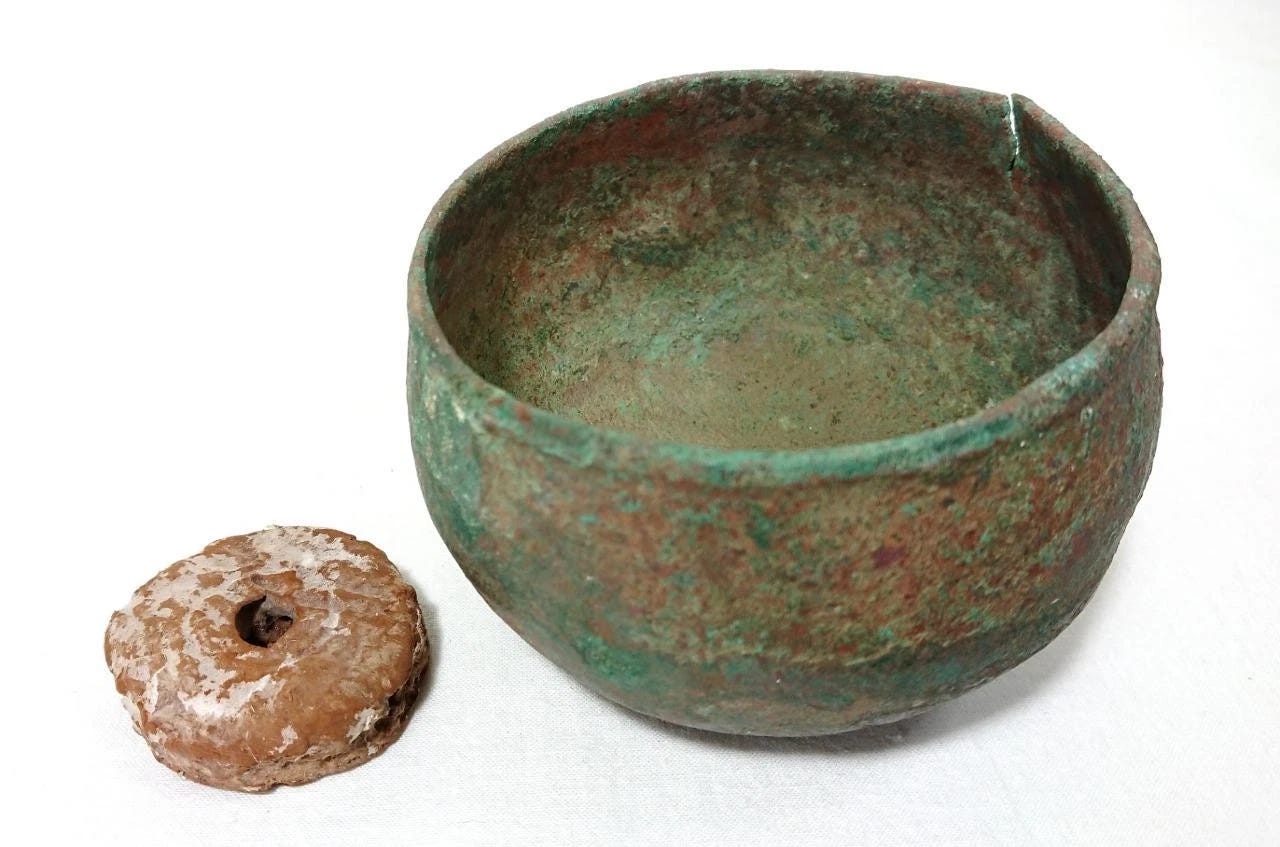
An Etruscan bronze bowl, 5th–3rd century BCE, 11 cm × 8 cm, shown with a separate pierced stone disc of the kind discussed below. Etruscan bronze bowl with a separate pierced disc, currently on the open market. Photograph from the sale listing (eBay item 188250725985).
A recurring pattern in the museum drawer and the antiquities trade is the bowl found near a stone — a ring- or torus-shaped stone, pierced through the centre, of a size to seat in a bowl’s base or over its central boss. Catalogued separately, they look like a dish and a loom-weight. Set together, they are the parts of one machine: the torus is the pivot or the float-collar, the bowl is the dial, and a magnetised core in the ring would drive the rotation of Section II. This is the taphonomy of a lost instrument — how it would look after two and a half thousand years and several owners. Composite tools do not survive composite. The wooden float rots, the cord perishes, the lodestone (Mohs 5.5–6.5, unremarkable to the eye once demagnetised by time or heat) is discarded as “a stone,” and the bronze bowl enters the catalogue alone, its function amputated. The reason we have no labelled ancient compass is that we have its parts, shelved apart, under the wrong names. This is the search instruction that finds the proof — it tells the excavator and the curator exactly what pairs to look for.
And the Etruscans supply the missing Western counterpart to the Chinese diviner’s board. The Liver of Piacenza is a life-size bronze model of a sheep’s liver, cast in the second century BCE, its surface divided into sixteen marginal regions and inner cells, each inscribed with the name of an Etruscan deity — a map of the heavens projected onto bronze, used by the haruspex to read the sky’s will:
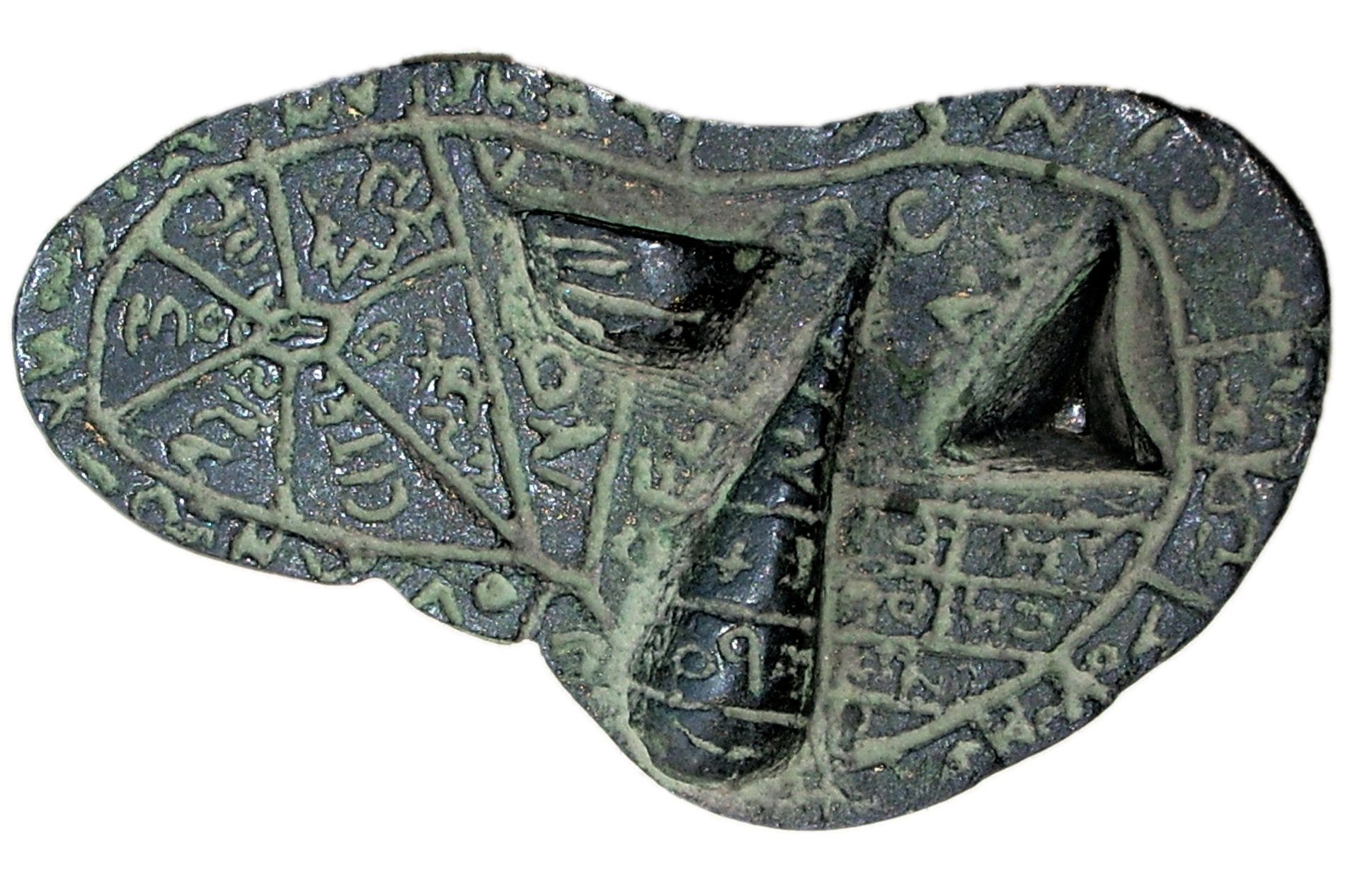
The Liver of Piacenza: a bronze Etruscan instrument, c. 2nd century BCE, its surface divided into sixteen named celestial regions — a Western cosmograph directly comparable to the Chinese diviner’s board on which the si nan turned. The Liver of Piacenza, Etruscan bronze, Museo Civico, Piacenza. Photo CC BY-SA 3.0.
Set the Piacenza Liver beside the Chinese shi of Claim 2 and the resemblance is structural, not superficial: a flat bronze surface, divided into named directional regions, the sky’s order written on metal so that a turning indicator can be read against it. Etruria and Han China, with no plausible contact, produced the same idea — a marked bronze plate for reading orientation and fate — and Etruria produced it in bronze, before Rome existed. The board and the bowl are both pre-Roman. The “Roman” frame of Claim 1 looks thinner with every object we lay on the table.
(The photograph above is from the object’s public sale listing.)
Claim 8 — The spiral is a record, not a decoration
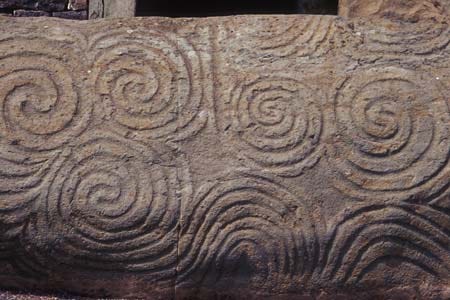
The entrance stone at Newgrange (Brú na Bóinne), Ireland, c. 3200 BCE — older than Stonehenge and the Pyramids. Its triple spirals are aligned to the midwinter sunrise. Newgrange entrance stone, c. 3200 BCE. Photo “Nomadtales”, CC BY-SA 3.0.
The triskelion and the triple spiral are usually called “Celtic decoration.” But the most famous example — the entrance stone at Newgrange, carved around 3200 BCE — sits at a tomb whose passage is engineered so that the rising sun of the winter solstice, and only the winter solstice, drives a blade of light to the back chamber. The spirals are on the threshold of an instrument that measures the year.
Consider what the sun actually does over a year, traced on a fixed surface. Because the Earth’s axis is tilted (obliquity ε ≈ 23.44°) and its orbit is slightly elliptical, the sun’s position at a fixed clock-time draws a figure-of-eight in the sky — the analemma:
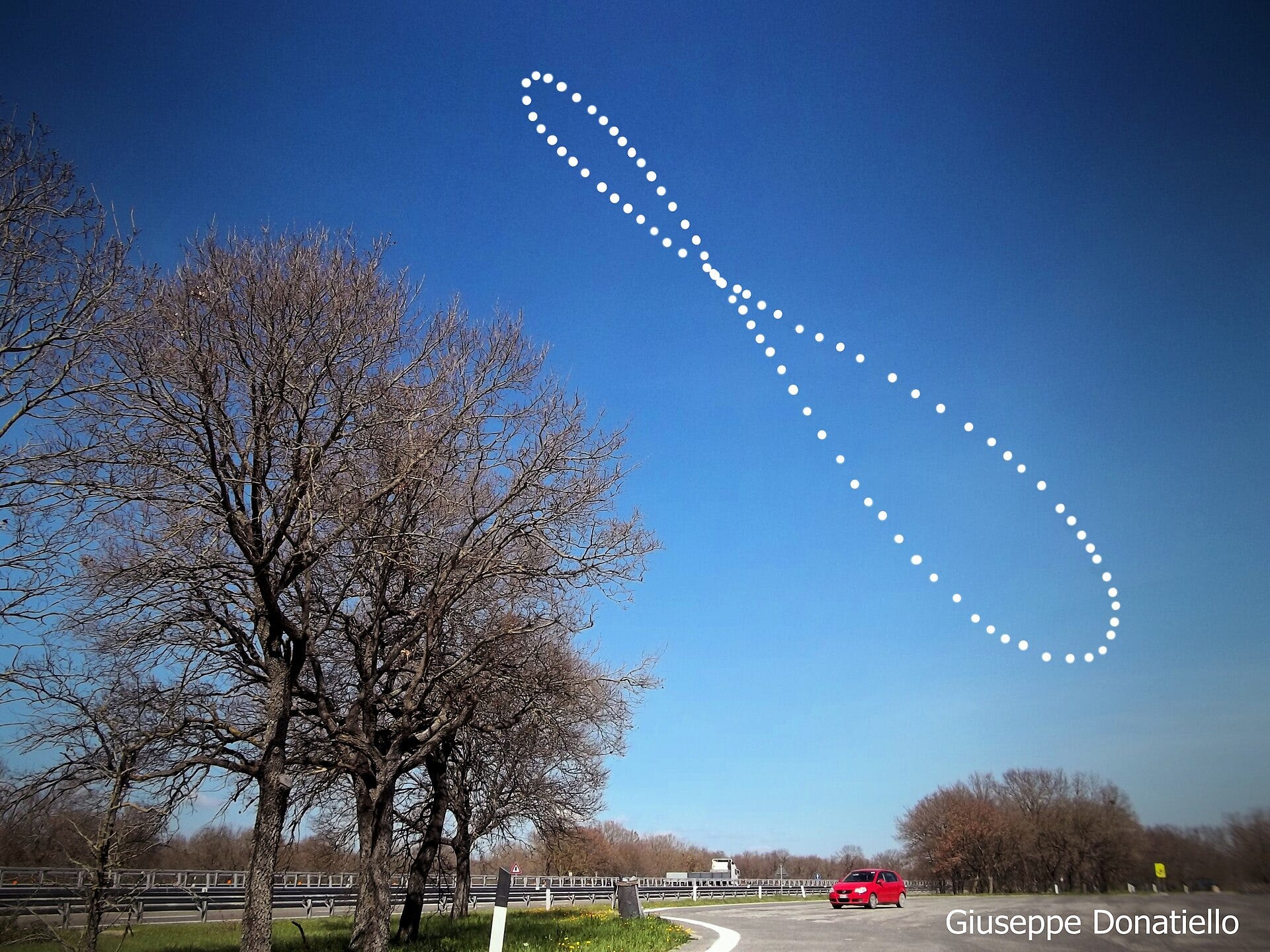
The analemma: the sun’s position photographed at the same clock-time across a year traces a figure-of-eight. A spiral/looped solar record is what the sky actually writes. Analemma over Italy, 2015–16. Photo Giuseppe Donatiello, CC0.
And the azimuth of sunrise — where on the horizon the sun comes up — swings back and forth through the year between the solstices. The mathematics is exact. At latitude φ the rising sun’s azimuth A (measured from north) for solar declination δ is
For South Wales (φ ≈ 51.5°N), with δ ranging from +23.44° at midsummer to −23.44° at midwinter:
EventDeclination δSunrise azimuth A (from N)Summer solstice+23.44°50.3° (NE)Equinoxes0°90.0° (due E)Winter solstice−23.44°129.7° (SE)
The sun’s rising point sweeps a 79.4° arc of the horizon over the year and then returns — a swing that closes on itself, year after year. A people watching the horizon for generations, marking where the sun turns back at each solstice, are recording a closed, returning, looping motion. The spiral is the natural notation for a cyclic record — the obvious mark for “this came round again.” Read this way, the triskelion is not ornament applied to a calendar-tomb; it is the data the tomb was built to take, carved on its door. Three spirals for three turning-points — the two solstices and the balance of the equinox — the year’s geometry, drawn.
And this is surveying in the most literal sense. To know, for your own latitude, exactly where on the horizon the sun will break at midsummer and midwinter is to be able to lay out a monument to catch it — to plant the stones, cut the passage, and orient the tomb before a single block is raised. The azimuths in the table above are not just an astronomer’s note; they are a builder’s setting-out instructions.
And we are not guessing that Bronze Age Europe thought in exactly these angles: it left one cast in bronze. The Nebra sky disc — buried in central Germany around 1600 BCE, the oldest known concrete image of the cosmos — carries two gold arcs on its rim, and those arcs span an angle of 82°: precisely the angle between the sun's setting points at midsummer and midwinter at the latitude where the disc was made (51°N). Move north and that angle opens toward 90°; move south and it closes toward 70°. The makers had measured the solstice swing of their own horizon and fixed it permanently in metal — a solstice protractor three and a half thousand years old, from the same Bronze Age world as the Welsh cup of Claim 5. (The disc's precise date and find-spot were challenged in 2020; the challenge has been widely rebutted, and in any case the 82° is on the object whatever its date.) The azimuth table above is not a modern anachronism imposed on these people. It is a calculation they had already made.
The aligned monuments of the Atlantic west — Newgrange, the stone rows, the solstitial passage graves — are the surveying instrument’s work left in the ground at full size.
And the grandest builders of the ancient world did precisely this, with named instruments, as a sacred rite. The Egyptians oriented their temples and pyramids using two tools that survive in museums: the merkhet — the "instrument of knowing," a sighting-bar carrying a plumb-line — and the bay, a slotted sight cut from the central rib of a palm leaf. One observer sighted a star through the slit of the bay; a second moved until the merkhet's plumb-line crossed the same line of sight, and the bisected angle gave true north. That is instrument-aided astronomical surveying, in hand, thousands of years before the textbook will grant it. And it was holy: the founding of every great temple opened with the rite of pedj-shes, the "stretching of the cord," in which the king and the goddess Seshat — the deity of measurement herself — drove the stakes and drew the line taut against the stars, a ceremony attested as far back as c. 2650 BCE. A goddess of surveying, laying out a building by the heavens. The act this essay is trying to recover was, to the ancient mind, no technician's chore. It was a sacrament — which is exactly why its instruments keep surfacing as sacred objects: buried with kings, modelled for the dead, cast as the vessel in which the Mandate of Heaven itself was held.
Claim 9 — Delphi: the serpent, the vapour, and the eye of stone
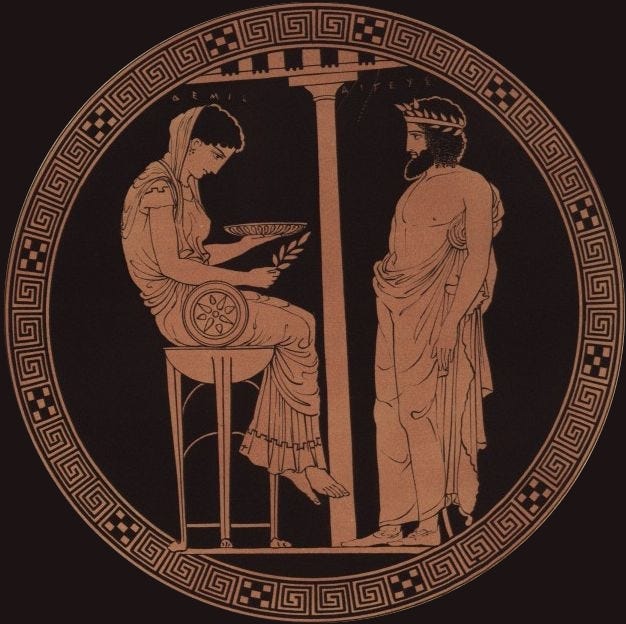
Themis, seated on the Delphic tripod, prophesies to Aegeus. The Pythia delivered the oracle seated over the omphalos, by the cleft, on the three-legged cauldron. The Pythia (as Themis) on the Delphic tripod, Attic red-figure kylix by the Kodros Painter, c. 440–430 BCE. Antikensammlung Berlin. Public domain.
Everything in this essay converges at Delphi, which is why I painted it before I had reasoned it. The oracle sat on a three-legged cauldron (Claim 6) over the omphalos (Claim 3), at a cleft from which a pneuma — a vapour, a breath — was said to rise and induce the prophetic trance. The sanctuary’s founding myth is the slaying of Python, the great serpent of the place; the priestess is the Pythia; the serpent coils through the whole site.
The vapour is not only myth. The geologists de Boer, Hale and Chanton (Geology, 2001) showed that two faults cross beneath the temple and that the bituminous limestone there can release light hydrocarbons — they argued ethylene, a sweet-smelling gas with known anaesthetic and euphoric effects — providing a physical basis for the trance. The reading is contested: Foster and Lehoux (2007) argued the measured concentrations were too low to intoxicate. I present it as a live scientific debate, not a settled finding — but the structure is what matters here: a vapour, channelled and delivered, rising through the apparatus.
And the apparatus, in the iconography and in my reconstruction, is serpentine. A coiled tube — an ouroboros, the snake that eats its tail — is the natural shape for a vapour conduit: wind the channel and you lengthen the path, slow the gas, and (if the bore narrows within the coils) accelerate and spin it at the mouth, so that what issues at the centre is a turning column of breath. I rebuilt this in paint and saw what the coil does to the flow. Set a stone in the serpent’s eye at the centre — a lodestone, a lens, a polished boss — and the instrument’s three registers fuse: the omphalos-pivot of the orienting bowl, the vapour-engine of the trance, and the symbol of eternal return, all in one coiled form.
The serpent here is not the serpent of later Christian fear. It is the caduceus:

The caduceus of Hermes: two serpents twined about a central staff, surmounted by wings. Hermes was the god of boundaries, travel, and the crossing of thresholds — the patron of those who find their way. Caduceus. Public domain.
Two serpents wound about a central axis, crowned with wings — the staff of Hermes, god of travellers, boundaries, messages, and the crossing between worlds. (It is worth correcting a common error: the medical Rod of Asclepius has one snake; the caduceus has two, and belongs to the guide of souls and wayfarers, not the healer.) The double helix about a fixed axis is, again, the form of the instrument: two coils, one centre, motion organised around a still point. Hermes is the god you pray to when you need to find your way — psychopomp and navigator at once.
Claim 10 — The bowl remembers: form as memory across catastrophe
Step back from the table of objects and ask the deepest question: why the persistence? Why does the bowl-with-a-centre recur across China, Greece, Persia, Britain, and Wales, over four thousand years, through the fall of every civilisation that made it?
My answer, and the title of this piece: the memory is kept in the shape. When a civilisation collapses — when the Bronze Age world came apart around 1200 BCE, when Rome fell, when the climate catastrophe of 536 CE darkened the sun for a year — the libraries burn and the manuals are lost, but the objects survive in the ground, and the forms survive in the hand. A coppersmith who can no longer read the treatise can still beat out the bowl his grandfather made, because the body remembers the shape even after the mind has lost the reason. Function decays into form; form decays into ornament; ornament is then mistaken for the original meaning. The graded holes of the dodecahedron become “decoration”; the gimbal-chains of the hanging bowl become “for hanging a lamp”; the omphalos of the phiale becomes “a place to put your fingers.” The instrument survives as a fossil of itself.
This is why the magnetite crystal is, to me, the perfect emblem of the whole argument. Lodestone — the working heart of the device — grows, untouched by any hand, into the octahedron and the rhombic dodecahedron: the stone itself is twelve-faced. The geometry the ancient bronzesmith cast in his dodecahedron is the geometry magnetite assumes in the dark of the rock. (I am careful here: the regular pentagonal dodecahedron of Plato and the rhombic dodecahedron of the mineral are different solids — same face-count, different faces. The resonance is real; the identity is not. To collapse them would be exactly the false-precision this essay refuses.) But the rhyme stands: the shape of the orienting stone, the shape of the orienting instrument, and the shape Plato gave to the cosmos all carry the number twelve. The bowl remembers because the rock remembers; the form is older than any of its makers.
IV. Reading the assemblage: number, symbol, and meaning
The ancients did not separate the disciplines I have been separating for clarity. To them, the mathematics was the symbol and the symbol was the sacred. So let me, at the end, read the whole table as they would have.
Number. Two numbers organise everything above. Three is the number of stability and structure: three legs of the ding and the tripod, three chains of the hanging bowl, three points that fix a plane, three turnings of the triskelion, the three of the Delphic cauldron. Twelve is the number of the cosmos and the cycle: twelve faces of the dodecahedron, twelve months and signs the instrument must track, the twelve-fold habit of the magnetite crystal. Three builds the instrument; twelve is what the instrument reads. And three appears again inside twelve — for a year has its two solstices and the balance between them, the same triadic structure the spiral records. The persistent suggestion, which I state as a theme and not a proof, is that these makers thought in threes where we have been trained to think in twos — a ternary structure of stability-and-return rather than a binary of either/or. The instruments are built on three points because three points are stable; perhaps the minds were too.
Symbol. The omphalos is the centre; the ouroboros is return; the caduceus is the way between. A device that finds the centre, reads the cycle, and guides the traveller across the threshold is, symbolically, the same object three times over. The bowl that orients you in space is indistinguishable, in this symbolic grammar, from the cauldron that returns you to life and the navel that locates you in the cosmos. The Welsh and Irish cauldron of rebirth, the Greek krater, the Persian phiale, the Chinese ding — these are one vessel under four skies.
One older echo. The alchemists, heirs to this same Greco-Egyptian world, kept the idea in a single phrase — the vessel is the work. And their prima materia, the black stone from which the whole work begins, has a literal counterpart here: lodestone is the one black stone that, alone among minerals, already points the way out of the dark. I let the resonance stand at that, and take it no further.
And one personal note, which belongs here and which I have kept honest. Before I had assembled the argument above, I had already painted the scene this essay closes on — a serpent-cauldron, a descent underground, a spiral path, a stone set in the dark rock, and a woman bent over a great riveted bronze cauldron. I painted it the way I always work: from long study of every account and every illustration of these things that I could find. What I had not yet done was reason out what any of it was for. The picture set the whole assembly down — serpent, cauldron, centre-stone, the figure at the bronze bowl — before I had understood that those forms describe an instrument. The image came first; the explanation followed. I show it to you at the close and let you weigh the order.
V. What I claim — and what would break it
So that the claims are staked honestly, the ledger:
I claim the physics: a lodestone fixed to a floated bowl will rotate the bowl to magnetic north, and the mathematics shows the device would be robust and tunable. This is not in doubt.
I claim that the si nan-form (magnet on marked plate) and the wet compass are real, attested, and Chinese; that Shen Kuo recorded declination in 1088; and that the floating-bowl variant is the form least likely to be recognised in the archaeological record.
I propose — as hypotheses, falsifiable by replica and experiment — that the graded-hole dodecahedron is a combined magnetic, astronomical, and surveying sight; that some three-suspension hanging bowls are gimballed instruments; that bowl-and-ring-stone pairs are the dismembered parts of orienting devices; and that the omphalos/phiale form encodes a portable origin of coordinates — a survey datum you can carry.
What I don’t claim is dishonest certainty: no single object has yet been lifted from the ground with its lodestone still in place and a label attached. But that absence is the theory’s own prediction — composite instruments do not survive composite — and the contested cases (the Han spoon, the Delphic vapour) I have flagged as contested. None of this softens the thesis; it tells you exactly where to dig.
I challenge the “Roman” label on the dodecahedra. The archaeology dates their deposition, not their design; no classical text names them; the Carmarthen example was recorded by depth, not by stratigraphy. The label is a ceiling, not a finding. The Etruscan bronze bowl (5th–3rd c. BCE) and the Liver of Piacenza (2nd c. BCE) show the bowl-and-board tradition flourishing before Rome existed.
I claim the stakes openly. If the dodecahedron is the sight I argue it is, then instrument-aided direction-finding and land-survey are older by millennia than the textbook allows; the technical sophistication of the Etruscan, Chinese, Greek, and Welsh worlds must be revised sharply upward; and the comfortable story in which precision navigation and surveying are a late European achievement does not survive. This is a large claim. It is also a falsifiable one — which is exactly why it should be tested rather than dismissed.
I claim, finally, that the recurrence of the centred bowl across four millennia and a dozen cultures is a phenomenon that deserves a unified investigation — and that the burden now lies with the orthodox “unrelated coincidences” reading to explain the graded holes, the three-point suspensions, the navel-pivots, and the persistence through catastrophe at least as economically as the hypothesis offered here.
Not handed down from a single source, then, but found over and over because the world itself kept handing it to us — and traded between neighbours until it looked like one thing.
The claims are staked. I am asking the institutions that hold these objects — the National Museum Wales above all, on whose ground the oldest of these forms was found — to test them. Build the replica. Float the bowl. Look through the holes. The dig is the answer.
Coda — the painting
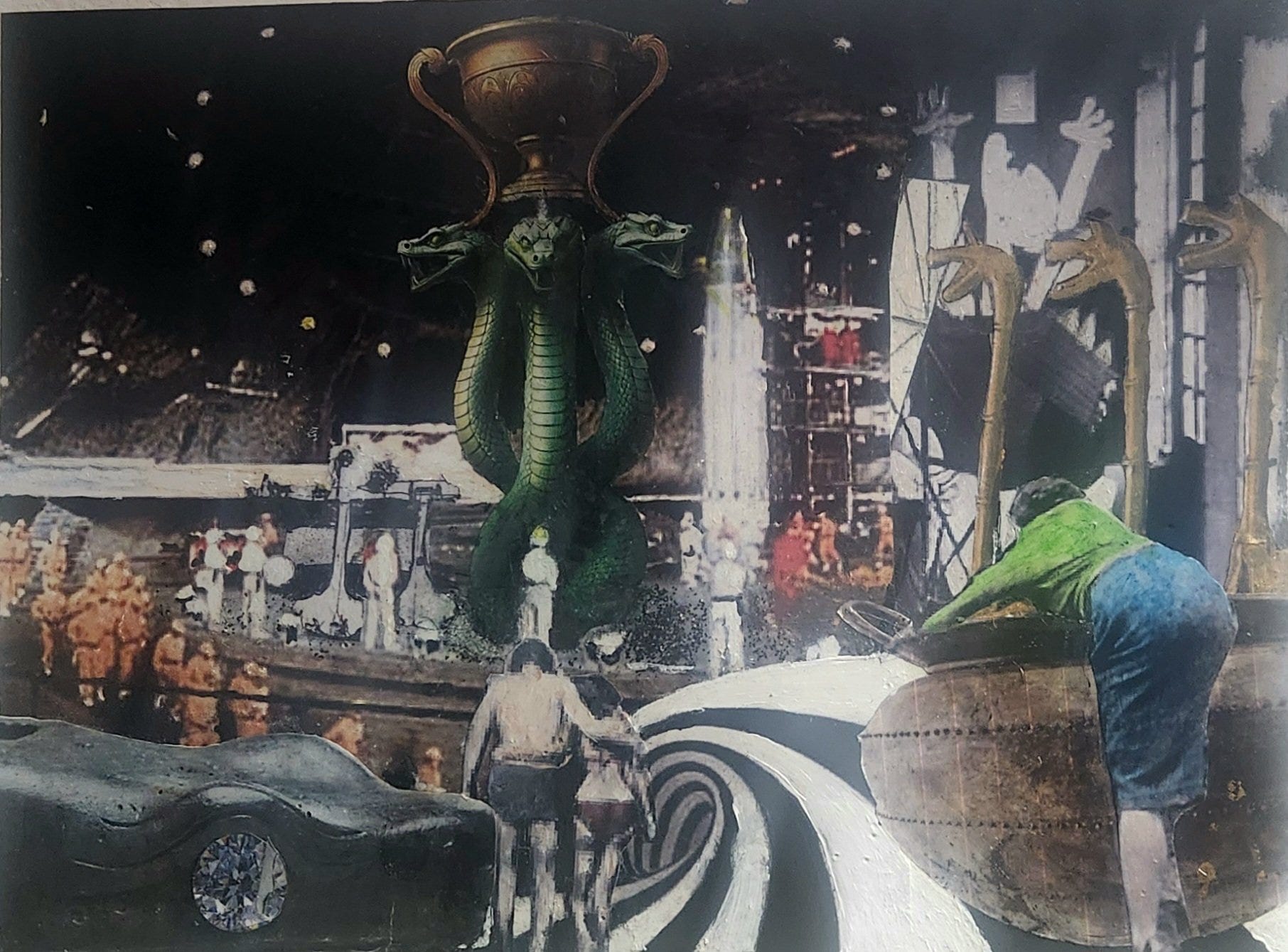
The painting, February 2026 (the author).
The serpent-cauldron, the ouroboros, the descent underground, the ranked figures of the dead, the spiral path, the stone set in the dark rock — and, lower right, a woman bent over a great riveted bronze cauldron: the operation this essay reconstructs from physics and archaeology. I painted it from long study of the sources — every account and image of these forms that I could find — before I had reasoned out what they were for. I offer it not as proof but as the place this began: the picture first, the understanding after.
Image credits & licences
The header painting is the author’s own work (© the author). The Carmarthen dodecahedron plate is reproduced from The Antiquaries Journal (1924) and is public domain by age (the object is held by the Society of Antiquaries of London). All photographs marked Commons below are reproduced under the stated open licences, each linking to its source. The Llanblethian cup (Claim 5) is rights-reserved and described in the text, not reproduced. The hanging-bowl plate (Claim 4) is an archival illustration, public domain by age; the Etruscan bowl photograph (Claim 7) is from a public sale listing (eBay item 188250725985).
Header painting — © the author, February 2026. All rights reserved.
Carmarthen dodecahedron — archival plate, The Antiquaries Journal 4.3 (1924); object held by the Society of Antiquaries of London; public domain by age.
Bronze dodecahedron (Continental example) — “Itub”, CC BY-SA 3.0. https://commons.wikimedia.org/wiki/File:Roman_dodecahedron.jpg
Magnetite (lodestone) — Robert M. Lavinsky / iRocks.com, CC BY-SA 3.0. https://commons.wikimedia.org/wiki/File:Magnetite-118736.jpg
Si nan reconstruction — CC BY-SA 3.0. https://commons.wikimedia.org/wiki/File:Model_Si_Nan_of_Han_Dynasty.jpg
Twenty-eight lunar mansions — public domain. https://commons.wikimedia.org/wiki/File:Twenty-eight_mansions.jpg
Etruscan bronze bowl with pierced disc — photograph from sale listing, eBay item 188250725985 (seller staffyfrank11).
Liver of Piacenza — Museo Civico, Piacenza, CC BY-SA 3.0. https://commons.wikimedia.org/wiki/File:Piacenza_liver.jpg
Phiale mesomphalos — The Metropolitan Museum of Art, CC0. https://commons.wikimedia.org/wiki/File:Gilt_silver_phiale_mesomphalos_MET_DP366342.jpg
Omphalos of Delphi — “Zde”, CC BY-SA 4.0. https://commons.wikimedia.org/wiki/File:Omphalos,_AM_of_Delphi,_201425.jpg
Celtic hanging bowls (plan and section) — archival illustration plate, public domain by age.
Sutton Hoo great hanging bowl; object held by the British Museum (Mound 1 ship burial, c. 625 CE); public domain by age.
St Ninian’s Isle treasure (bowl) — Pictish silver hoard, Shetland; object held by National Museums Scotland. Photograph used for reference.
Bronze ding — Gary Lee Todd, CC0. https://commons.wikimedia.org/wiki/File:Late_Western_Zhou_Bronze_Ding_03a.jpg
Newgrange entrance stone — “Nomadtales”, CC BY-SA 3.0. https://commons.wikimedia.org/wiki/File:Newgrange_Entrance_Stone.jpg
Analemma — Giuseppe Donatiello, CC0. https://commons.wikimedia.org/wiki/File:Analemma_A14_2016_(25907420783).jpg
Pythia / Themis on the tripod — Kodros Painter, Antikensammlung Berlin, public domain. https://commons.wikimedia.org/wiki/File:Themis_Aigeus_Antikensammlung_Berlin_F2538.jpg
Caduceus — public domain. https://commons.wikimedia.org/wiki/File:Caduceus.svg
Central revolving fish — antiquarian reconstruction plate
Antikythera mechanism (Fragment A) — National Archaeological Museum, Athens (cat. 15987); photo "Marsyas", CC BY 2.5. https://commons.wikimedia.org/wiki/File:NAMA_Machine_d%27Anticythère_1.jpg
Floating compass needle on water — CC BY-SA 3.0. https://commons.wikimedia.org/wiki/File:Compass-floating_needle_on_water.jpg


.jpg)


Select sources
“Roman Dodecahedron from Wales,” The Antiquaries Journal 4.3 (July 1924), 273–274 (the Carmarthen find of 1768; single-cast, graded perforations).
“Dodecahedrons Again,” The Antiquaries Journal (the corpus discussion; DOI 10.1017/S0003581500063484).
Plato, Timaeus 53c–56c, 55c (the five regular solids; the dodecahedron and the cosmos).
Wang Chong, Lunheng (Discourses Weighed in the Balance), c. 80 CE (the “south-controlling spoon”).
Shen Kuo, Mengxi Bitan (Dream Pool Essays), 1088 CE (floating magnetic needle; magnetic declination).
J. B. Carlson, “Lodestone Compass: Chinese or Olmec Primacy?,” Science 189.4205 (1975), 753–760 (the polished magnetic-haematite bar from San Lorenzo; independent invention).
Lucretius, De Rerum Natura VI (magnetic attraction in verse); Pliny, Natural History (Timochares and the lodestone vault of the temple of Arsinoë); Plato, Ion 533d (the “stone of Heraclea”) — ancient Mediterranean knowledge of the lodestone.
T. Freeth et al., “Decoding the ancient Greek astronomical calculator known as the Antikythera Mechanism,” Nature 444 (2006), 587–591 (a misread instrument recognised only after seventy years).
G. Ropars, A. Le Floch, J. Lucas et al., “A depolarizer as a possible precise sunstone for Viking navigation by polarized skylight,” Proceedings of the Royal Society A (2011/2013); the Alderney calcite crystal from the 1592 wreck.
The Nebra sky disc (Landesmuseum für Vorgeschichte, Halle; c. 1600 BCE): the two gold horizon-arcs span 82°, the solstice-sunset angle at 51°N.
J. Z. de Boer, J. R. Hale & J. Chanton, “New evidence for the geological origins of the ancient Delphic oracle (Greece),” Geology 29.8 (2001), 707–710. (The toxicological defence is H. R. Spiller, J. R. Hale & J. Z. de Boer, “The Delphic Oracle: A Multidisciplinary Defense of the Gaseous Vent Theory,” Clinical Toxicology 40.2 (2002), 189–196.)
D. Foster & D. Lehoux, “The Delphic oracle and the ethylene-intoxication hypothesis,” Clinical Toxicology 45 (2007), 85–89 (the dissent).
C. G. Jung, The Archetypes and the Collective Unconscious (CW 9i).
F. Reynolds, National Museum Wales blog (the Llanblethian cup; acc. 38.37/1, c. 1950 BCE).
The Egyptian merkhet and bay sighting instruments (e.g. Science Museum Group, object co500) and the temple-foundation rite of pedj-shes (”stretching the cord”) with the goddess Seshat, attested from the reign of Khasekhemwy (c. 2650 BCE) — instrument-aided astronomical surveying as sacred act.
© 2026 the author. Text and the author’s painting all rights reserved. Reproduced images are credited to their open-licence holders above. This essay is one chapter of a larger work in progress, “The Bowl Remembers.”